Published: 14 August 2026Last updated: 14 August 2026Reading time: 12 minutes
A commercial cleaning audit should prove whether the contracted standard is being
delivered across offices, washrooms, reception areas, kitchens, communal spaces and
customer-facing areas. It should also create a clear record of evidence, scoring and
corrective action when something needs attention.
OfficesWashroomsTouchpointsFollow-up
In this guide
What a commercial cleaning audit should prove
What to check by area
How to score results consistently
When to capture notes and photo evidence
How to manage corrective actions
How audit software keeps the record together
Need audit software?
Use this checklist to define the process, then see how KleanFlo keeps audit
schedules, mobile checks, customer reports and follow-up connected.
What a commercial cleaning audit is trying to prove
A useful audit is not just a walkaround. It gives the cleaning company and the customer
a reliable record of what was checked, whether the site met the agreed standard, what
evidence was captured and what follow-up was required.
Commercial cleaning sites vary widely. A multi-floor office, a managed apartment block,
a retail store, a leisure venue and a facilities management contract all need different
levels of detail. The checklist should match the contract, the customer risk and the
areas that matter most.
The strongest audit checklist is practical enough for supervisors to use on site and
structured enough for managers to compare results across customers, sites and teams.
Before the audit: confirm the contract context
Before scoring anything, confirm what the cleaning specification includes. This avoids
marking items that are out of scope and helps the supervisor separate daily cleaning
standards from periodic, specialist or customer-controlled tasks.
Confirm the customer, site, contract, areas, tasks and frequencies.
Check whether the audit is routine, complaint-led, customer-requested or a reinspection.
Review previous audit scores, complaints, incidents and recurring problem areas.
Confirm site access rules, out-of-hours restrictions, keys, alarms and security notes.
Check whether periodic work such as floor care, high dusting or deep cleaning is in scope.
Commercial cleaning audit checklist by area
The audit should be organised around how the site is used. A reception area creates a
first impression, a washroom creates hygiene risk, an office needs presentation and
desk-area discipline, and a communal area may need both cleanliness and safety checks.
1. Reception, entrances and front-of-house areas
Entrance doors, glass, push plates and handles are clean and presentable.
Reception desk, visitor areas and shared counters are clean where included.
Floors, mats and entrance edges are clean, dry and free from visible debris.
Bins are emptied, liners replaced where required and surrounding areas are clean.
Skirting, ledges, signage and reachable surfaces are free from obvious dust build-up.
Any damage, access issue, spill risk or customer concern is recorded for follow-up.
2. Offices, desks and meeting rooms
Accessible desks, meeting tables and shared surfaces are cleaned where clear and in scope.
Chairs are aligned or reset according to the customer requirement.
Floors are vacuumed, swept or mopped to the agreed standard.
Bins are emptied unless restricted by the customer.
Light switches, handles and shared touchpoints are cleaned where included.
Confidential papers, personal items and restricted equipment are not disturbed.
3. Washrooms and hygiene areas
Toilets, urinals, seats, flush handles and surrounding areas are clean.
Basins, taps, splashbacks, mirrors and dispensers are clean and presentable.
Floors are clean, dry and free from visible waste, pooling or residue.
Soap, hand towels, toilet rolls and consumables are stocked to the contract standard.
Sanitary bins or specialist disposal units are managed by the correct provider where applicable.
Odour, drainage issues, leaks, damage, graffiti or repeated misuse are recorded.
4. Kitchens, tea points and break areas
Worktops, sinks, taps, splashbacks and shared surfaces are clean where included.
Tables, chairs and eating areas are clean and reset.
Floors are cleaned and free from food debris or spill marks.
Bins are emptied and waste areas are left presentable.
Appliances are only cleaned where they form part of the contract.
Fridges, microwaves, dishwashers or staff food areas are handled according to the customer's rules.
5. Corridors, stairs and communal spaces
Floors, stair treads, risers and landings are clean and safe.
Handrails, door plates, lift buttons and access panels are cleaned where specified.
Bins, recycling points and shared waste areas are controlled.
Walls, skirting, ledges and reachable surfaces are checked for obvious marks or dust.
Blocked access, trip hazards, wet floors or damaged flooring are reported.
High-traffic areas are reviewed for recurring issues or frequency changes.
6. Floors, periodic work and specialist areas
Floor cleaning method matches the surface and specification.
Vacuuming, mopping, buffing, scrubbing or floor-care work is checked against the plan.
Edges, corners, entrances and under-accessible furniture are reviewed.
Periodic work such as high dusting or deep cleaning is checked separately from daily tasks.
Specialist areas such as medical rooms, gyms or laboratories use site-specific checks.
Any area not accessible is recorded rather than scored unfairly.
7. High-touch points
Door handles, push plates and handrails.
Lift buttons, access panels, keypads and intercoms.
Shared counters, sign-in points and reception surfaces.
Kitchen taps, appliance handles and shared table surfaces.
Washroom taps, flush handles, dispensers and cubicle locks.
Any contract-specific touchpoint requested by the customer.
Scoring the commercial cleaning audit
Scoring should be simple enough for supervisors to apply consistently and clear enough
for cleaners, managers and customers to understand. If the score cannot be explained in
plain English, the audit is likely to create confusion.
ResultSuggested meaning
Pass / GreenThe area meets the agreed standard. A note or photo can still be captured as positive evidence.
Minor issue / AmberThe area is broadly acceptable but one item needs attention, coaching or follow-up.
Fail / RedThe area does not meet the expected standard and requires corrective action or reinspection.
Not applicableThe item is out of scope, inaccessible or should not be judged during that visit. Record the reason.
When to capture notes and photos
Photos are most useful when they explain a failed item, prove a completed corrective
action, show a repeated issue, evidence access restrictions or confirm the finish of
periodic work. Notes should add context that a photo cannot show.
Avoid capturing personal data, confidential documents, staff screens, visitor lists or
anything the customer has asked you not to photograph. Agree photo rules before audits
become part of the routine.
Mobile audit records help keep the score, notes and photo evidence together.
Corrective actions after a failed audit
The audit is only valuable if the business acts on the result. A failed washroom item,
repeated dusty ledge or missed bin should not sit in a report without ownership.
A clear cleaning audit trail
helps managers see which findings were assigned, completed, evidenced and reviewed.
FindingRecommended follow-up
One-off missed taskAssign the action, complete the task and record evidence where useful.
Repeated failureReview schedule time, training, specification clarity, access and whether the frequency is realistic.
Customer complaintRecord the issue, respond clearly, complete the corrective action and use the next audit to prove improvement.
Access problemRecord why the area could not be cleaned and raise it with the customer contact.
Safety concernEscalate immediately using the agreed site process.
Commercial cleaning audit checklist template
The checklist below can be adapted for offices, managed properties, retail sites,
leisure venues, healthcare support areas and multi-site commercial cleaning contracts.
Customer, site, date, auditor and audit type recorded.
Contract specification and areas confirmed before scoring.
Reception, entrances and front-of-house areas checked.
Offices, desks, meeting rooms and shared workspaces checked.
Washrooms, toilets, dispensers, consumables and odour issues checked.
Kitchens, tea points, break areas and waste points checked where included.
Corridors, stairs, lifts and communal areas checked.
Floors, edges, mats, periodic work and specialist areas checked.
High-touch points checked against customer expectations.
Scores, comments, photos and failed items recorded consistently.
Corrective actions assigned with ownership and follow-up date.
Customer report prepared or shared where appropriate.
What should be included in a commercial cleaning audit checklist?
A commercial cleaning audit checklist should cover the customer, site, areas checked, scores, comments, evidence, failed items and corrective actions. Typical areas include reception, offices, washrooms, kitchens, communal spaces, floors, waste points and high-touch surfaces.
How often should commercial cleaning audits be completed?
Frequency depends on contract value, site risk, customer expectations and previous performance. Many cleaning companies use quick supervisor checks alongside monthly or quarterly management audits.
Should customers see cleaning audit results?
Where appropriate, sharing clear audit results can improve confidence. Failed items should be paired with corrective action and evidence rather than sent as unexplained scores.
Is a commercial cleaning audit checklist the same as an inspection app?
No. The checklist defines what should be checked. A cleaning inspection app helps supervisors complete the checklist on mobile, capture evidence and submit results.
Want commercial cleaning audits that lead to action?
See how KleanFlo helps cleaning companies complete audits on mobile, share reports and keep corrective actions visible.

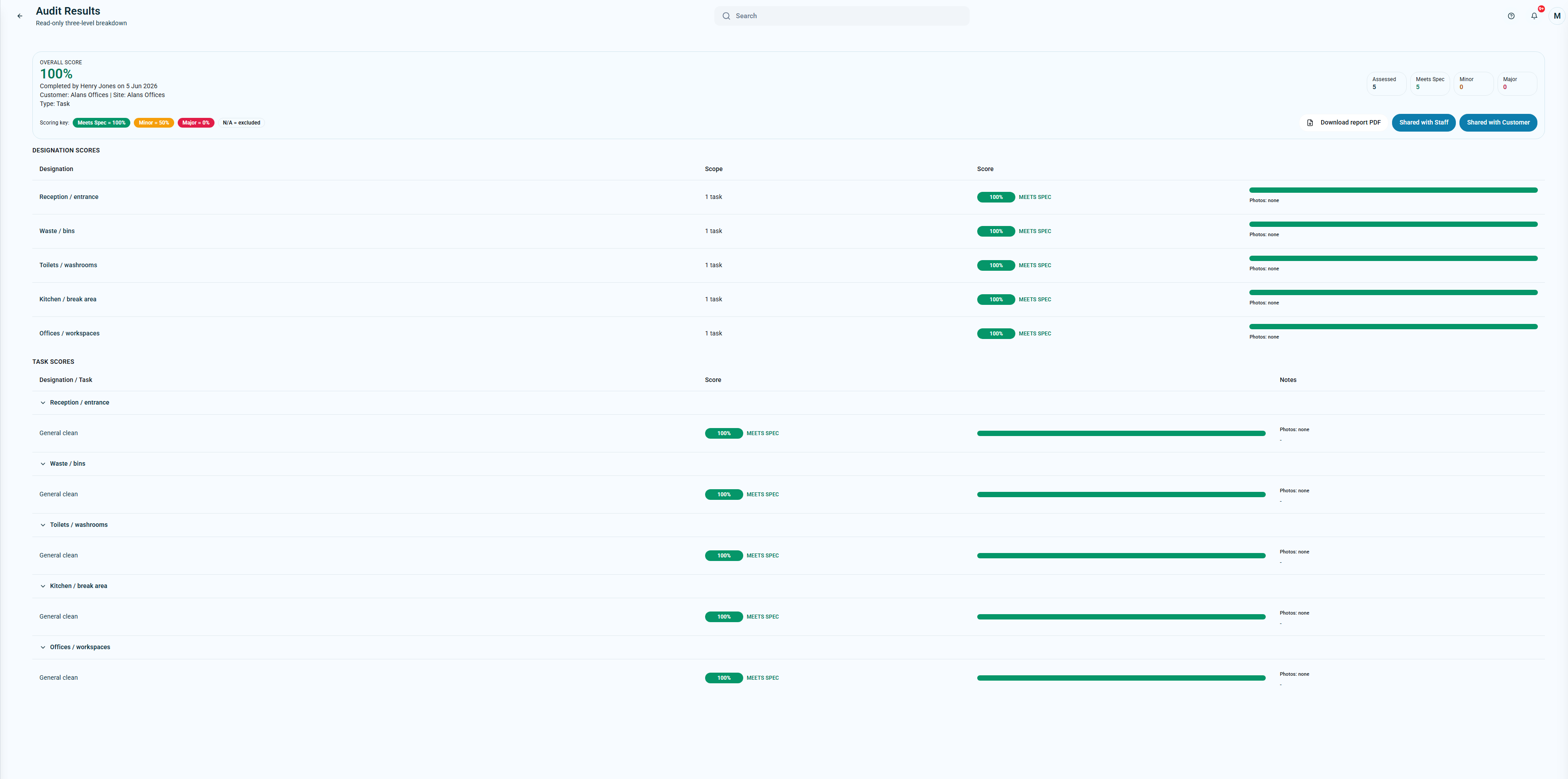
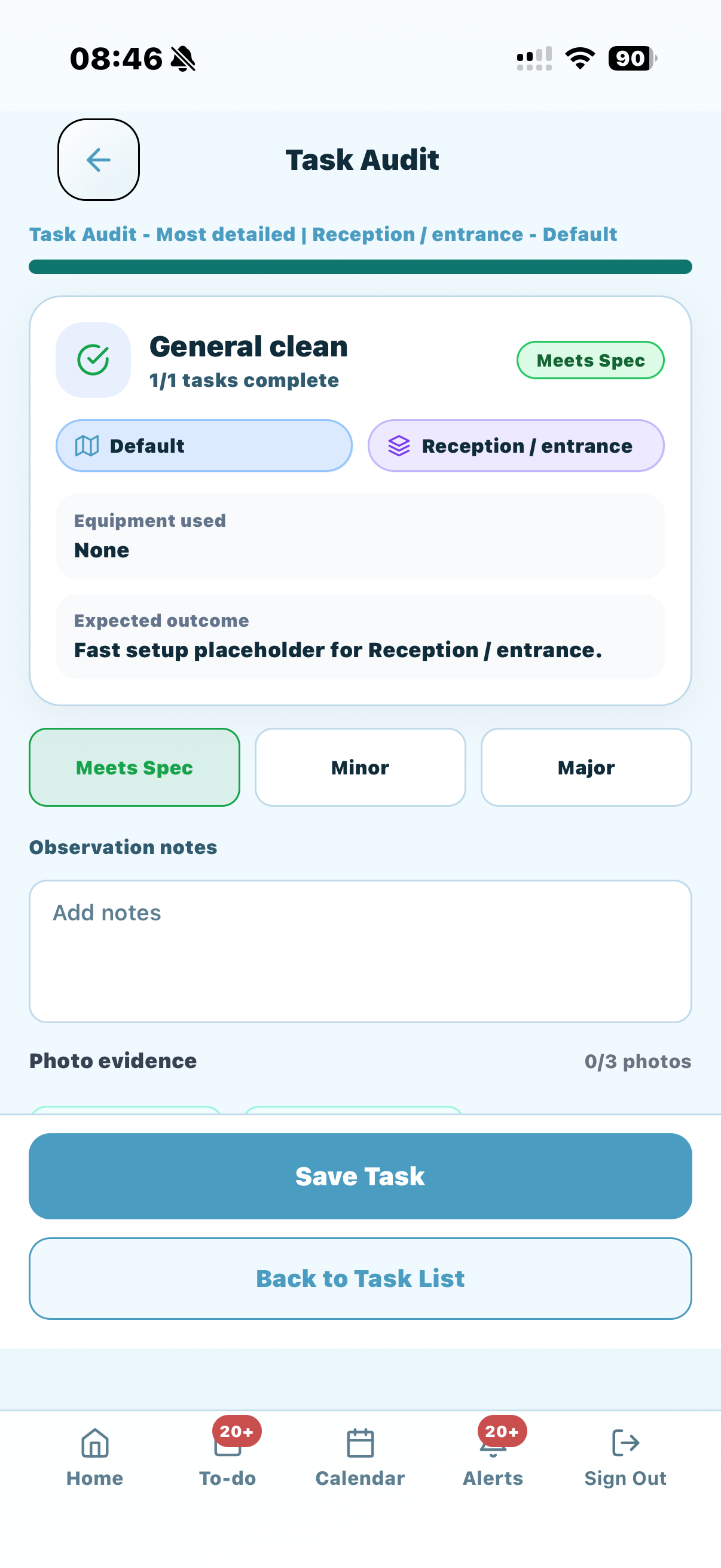 Mobile audit records help keep the score, notes and photo evidence together.