Cleaning audit trail software for evidence, history and follow-up
Published: 14 August 2026Last updated: 14 August 2026Reading time: 8 minutes
A cleaning audit trail helps managers answer the questions that come after an
inspection: what was checked, who checked it, what evidence was captured, what result
was shared and what corrective action followed.
The audit trail is the evidence chain behind a cleaning audit. It should show the
customer, site, audit type, auditor, date, areas checked, score, comments, photos,
customer visibility and follow-up action. Without that chain, managers are left
piecing the story together from spreadsheets, emails, PDFs and photos.
For a practical starting point, use a clear commercial cleaning audit checklist
so supervisors know what to check before the audit trail is built.
Audit trail itemWhy it matters
Who completed the auditCreates accountability and makes follow-up easier.
What was checkedShows whether the inspection matched the contract and site risk.
Scores and notesExplain the result in a way managers, staff and customers can understand.
Photo evidenceSupports proof of clean records, failed items and completed actions.
Corrective actionsShows that failed items were assigned, completed and reviewed.
Why spreadsheets and message threads weaken the audit trail
Paper forms and spreadsheets can record a score, but the context often sits somewhere
else. Photos may be on a supervisor's phone. Customer comments may be in email.
Corrective actions may be sent in a message. That makes it hard to prove what happened
when a customer asks for the history.
The weak point is rarely the audit visit itself. Most supervisors can walk a site and
spot standards that need attention. The problem is the record after the visit. If the
score is in one spreadsheet, the notes are in an email, the photos are on a phone and
the action was sent by message, nobody has a dependable history.
That becomes a bigger issue when a customer asks what happened last month, why the same
washroom failed again, whether a complaint was followed up, or which cleaner was shown
the feedback. A cleaning audit trail should make those answers easier to find.
Common gapBetter audit trail record
Photos stored separatelyPhotos attached to the exact audit item, score and site.
Actions sent by messageCorrective action linked to the failed item and responsible person.
Customer report rebuilt manuallyCustomer-visible report generated from the same audit record.
No comparison over timeAudit history available by customer, site, area, supervisor and result.
Example audit trail for a failed washroom check
A washroom issue is a good example because it can quickly become a customer complaint.
A weak audit record might only say "washroom failed". A useful audit trail shows the
full sequence behind that result.
The supervisor completed a scheduled audit at the customer site.
The washroom designation was scored amber or red using agreed definitions.
The failed item was recorded with a short note explaining the issue.
Photo evidence was attached where it helped explain the finding.
A corrective action was assigned to the relevant staff member or supervisor.
The action was completed and evidence was added where needed.
The result was reviewed by management and shared with the customer where appropriate.
That record is more useful than a static score. It shows that the issue was found,
understood, assigned and followed up.
Audit trails support proof of clean and customer confidence
Proof of clean is not just a photo. A stronger record shows what was inspected, whether
it passed, what evidence was captured and what the business did next. That is useful for
account reviews, complaints, contract renewals and quality conversations.
When customers need visibility, the KleanFlo customer portal
can help share audit results in a controlled way rather than sending disconnected PDFs
or screenshots.
Customer-visible audit reports help turn internal checks into a clearer service record.
What customers usually want from an audit trail
Most customers do not want to read every raw audit note. They want confidence that the
contract is being managed. The audit trail should let the cleaning company share the
right level of detail without overwhelming the customer or exposing irrelevant internal
commentary.
A clear summary of the audit result and overall standard.
Evidence for important findings, especially repeated or visible issues.
Confirmation that corrective action has been assigned or completed.
Trend information for recurring areas such as washrooms, entrances or communal spaces.
A record that supports account reviews, complaints and renewal conversations.
This is why audit trails and customer retention
are connected. A good record shows active management, not just inspection activity.
Corrective actions complete the audit trail
A failed audit item is not finished when it is recorded. The audit trail should show
who owns the action, what needs to be fixed, when it was completed and whether the
result was reviewed. This is where process automation
can help turn findings into practical follow-up.
The score definitions still matter. If teams are inconsistent about red, amber, green,
minor and major findings, the audit trail becomes harder to trust. Use
clear cleaning audit scores
so repeated findings can be reviewed fairly.
Audit trail requirements for multi-site cleaning contracts
Multi-site contracts make audit trails more important. A single supervisor may remember
what happened at one site, but a regional manager needs to compare standards across
customers, branches, buildings and teams. If every site uses a different spreadsheet or
sends evidence in a different way, the business loses visibility.
A stronger audit trail lets managers review patterns by site, area, audit type,
supervisor, score and action status. That helps the business spot whether the problem
is training, time allocation, access, specification clarity, customer behaviour or a
recurring operational issue.
Management questionAudit trail answer
Which sites keep failing?Filter audit history by customer, site and score.
Are washroom issues repeated?Review findings by designation, task or area type.
Are actions being closed?Track corrective action status and completion evidence.
Can we prove improvement?Compare audit history before and after corrective action.
Cleaning audit trail checklist
When reviewing your current audit process, check whether the business can reliably
answer these questions without chasing supervisors, searching message threads or
rebuilding reports manually.
Can you see which audits are scheduled, overdue, completed and reviewed?
Can each audit be traced to a customer, site, contract, area and auditor?
Are scores, notes and photos stored with the exact audit item?
Can failed items be turned into assigned corrective actions?
Can staff see the feedback that is relevant to their work?
Can customers see a clear report where appropriate?
Can managers review repeated issues by site, area, score or action status?
Can the business prove what changed after a complaint or failed audit?
How KleanFlo supports cleaning audit trails
KleanFlo cleaning audit software
connects scheduled audits, mobile checks, scores, notes, photos, customer reports,
staff feedback and corrective action follow-up. The result is a clearer audit trail
against the customer, site and contract.
Cleaning audit trail software keeps a record of what was checked, who completed the audit, what score was given, what evidence was captured, what was shared with the customer and what follow-up happened.
Is an audit trail the same as proof of clean?
They overlap. Proof of clean is usually evidence that cleaning or inspection happened. A full audit trail also includes the score, notes, history, customer visibility and corrective actions.
Why does a cleaning audit trail matter?
It helps managers answer customer questions, prove standards, review recurring issues, support account reviews and show that failed items were followed up.
Need a clearer record behind every cleaning audit?
See how KleanFlo connects audit evidence, customer reports and corrective action follow-up.

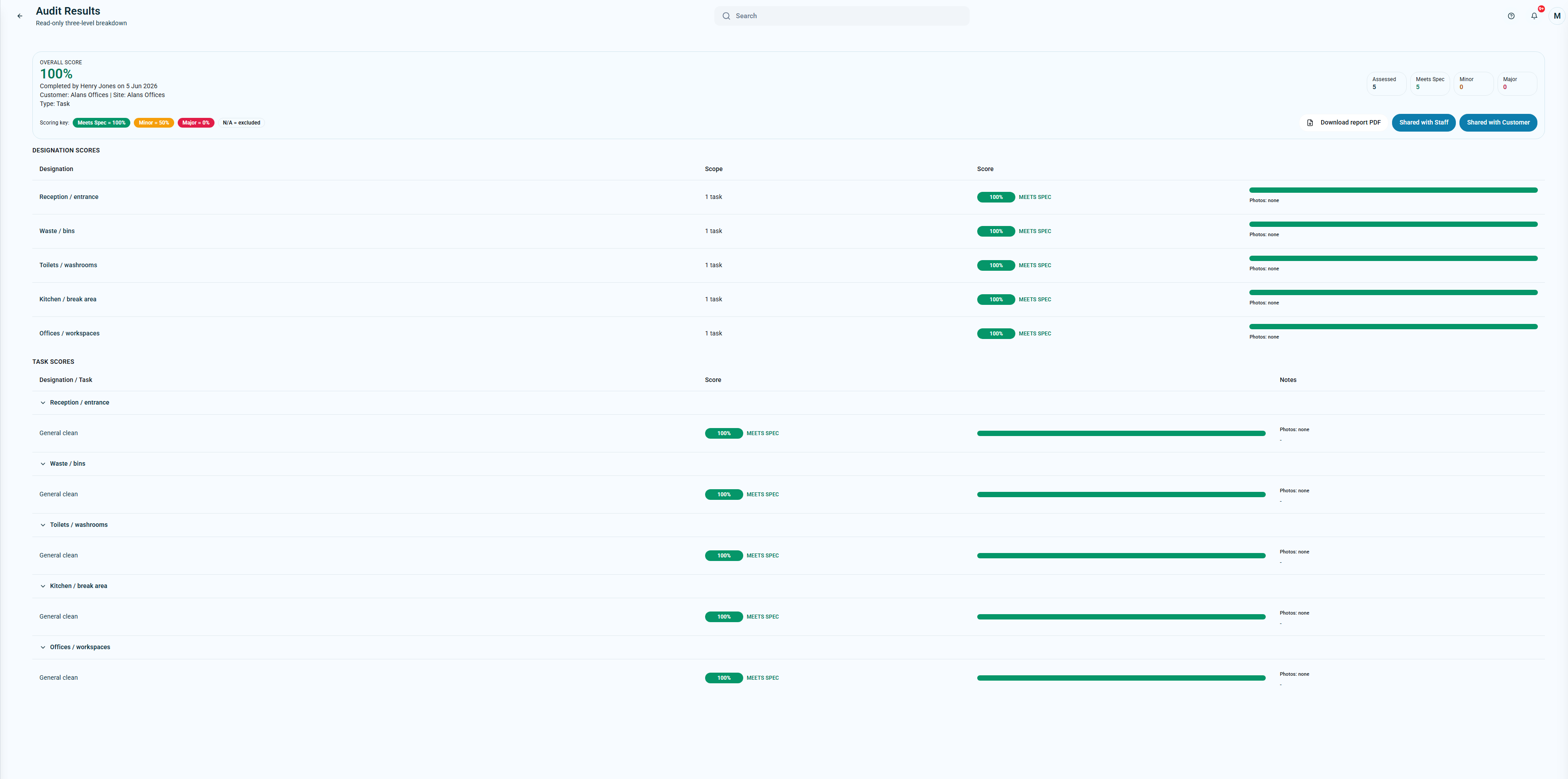
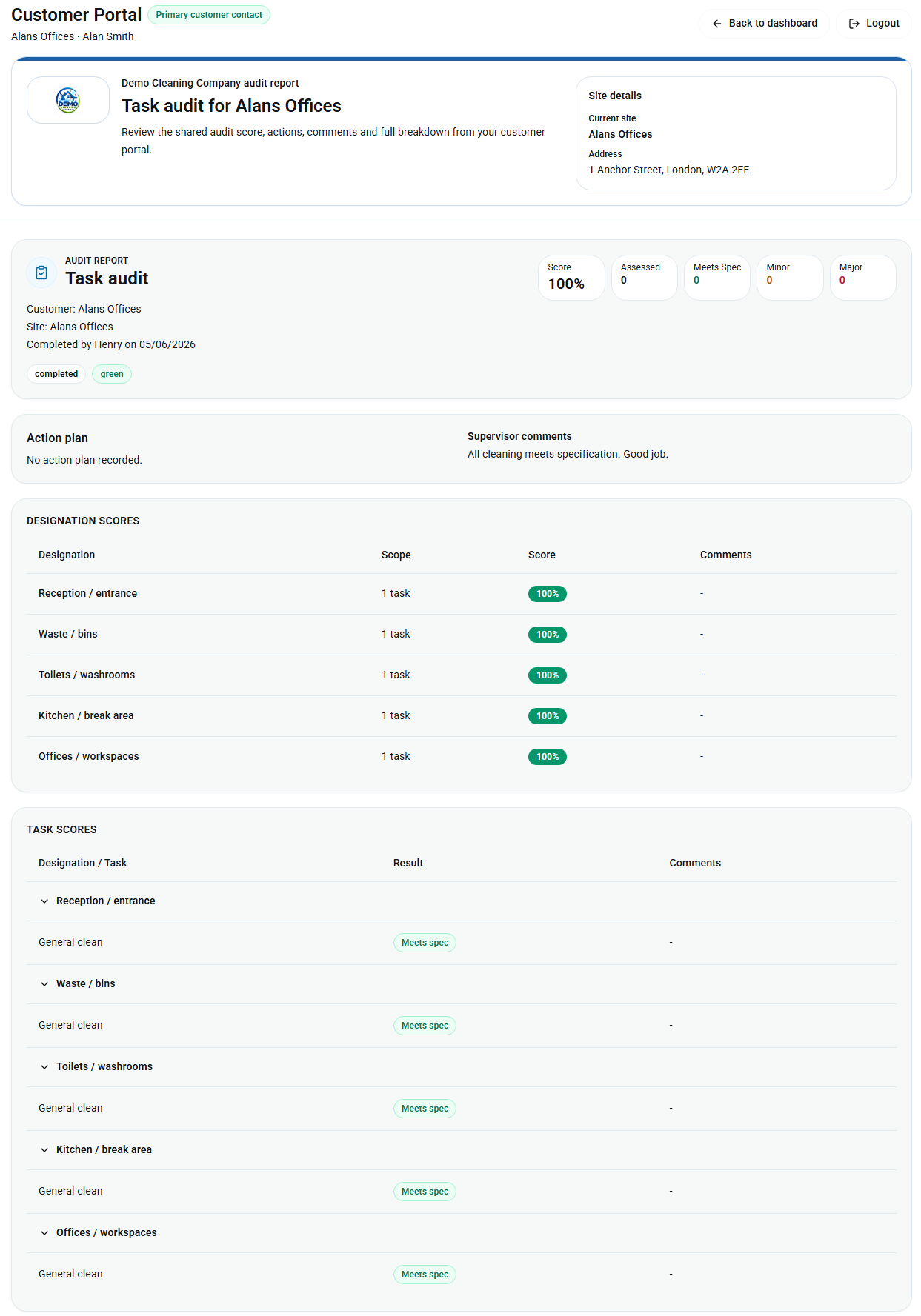 Customer-visible audit reports help turn internal checks into a clearer service record.