Cleaning time and attendance software with GPS, NFC tags, IVR call-in and geofence controls
Published: 13 July 2026Last updated: 3 August 2026Reading time: 12 minutes
Cleaning companies do not operate in one perfect attendance scenario. Some staff use mobile phones, some sites have poor signal, some buildings need stronger proof of presence, and some contracts still suit a controlled landline call-in process. KleanFlo now supports GPS check-in, NFC tags, IVR call-in and configurable geofence rules so each site can use the right attendance method.
See how KleanFlo supports GPS, NFC tags and known landline check-ins, so cleaning companies can evidence attendance without forcing every contract into the same process.
GPSNFC tagsKnown landlineTimesheet review
Proof of attendance
One check-in method does not fit every cleaning contract
Cleaning attendance is more complicated than a clock-in button. A cleaner may be working alone at 5am, covering a shift at a school, attending a distribution centre with poor mobile signal, cleaning a multi-storey building where GPS drifts, or completing a one-off job where the customer wants clear proof that someone arrived.
That is why KleanFlo supports multiple time and attendance methods. The goal is not to make attendance harder for staff. The goal is to give the business a practical proof-of-attendance setup that fits each site, employee, customer requirement and contract risk.
A deep cleaning time and attendance system should let the business choose the right proof method for the site, then bring every result back into one timesheet review workflow.
The core check-in options
KleanFlo now supports GPS check-in with geofence controls, IVR landline call-in from a known site number, and NFC tags fixed on site. Each option solves a different operational problem.
G
GPS check-in
Useful for mobile staff and smartphone workflows where the business needs location evidence linked to the planned job.
F
Geofence rules
Enforce check-ins inside the site geofence, or allow outside-geofence check-ins and flag them for review.
N
NFC tags
Useful where a physical NFC tag is fixed on site and staff must tap it to record attendance.
I
IVR call-in
Useful where a cleaner calls from a known site phone number, giving evidence that the call came from the customer location.
GPS check-in for mobile teams
GPS check-in is a strong option when cleaners already use a mobile device and the site is suitable for location-based attendance evidence. It can help managers review whether the employee was near the expected site when the check-in or check-out happened.
This is useful for mobile supervisors, multi-site cleaners, one-off jobs, cover shifts and teams working across different locations. It also fits naturally with the wider KleanFlo Staff mobile workflow: the cleaner can view the shift, check the site details, record attendance, report issues and check out from the same mobile experience.
GPS should still be treated as operational evidence, not as the only truth. Buildings, basements, phone settings and signal quality can affect location accuracy. The value comes from giving managers location context alongside the planned shift, site, cleaner, time and timesheet record.
Geofence enforcement or outside-geofence review
Geofencing gives the business a virtual boundary around the customer site. For some contracts, the right approach is strict: staff should only be able to check in when they are inside the approved geofence. That can reduce false check-ins and gives managers stronger confidence that attendance happened at the expected location.
For other contracts, strict blocking can create unnecessary operational problems. GPS can be imperfect around large buildings, dense town centres, basements, schools with multiple entrances, industrial estates, remote sites and buildings where the practical cleaning entrance is not the same as the mapped postal address.
KleanFlo supports both approaches. A site can enforce the geofence where the contract needs tighter control, or allow check-ins outside the geofence while clearly flagging the exception for manager review. That second option is important because it captures the attendance event instead of losing it, while still showing the office that the location needs checking.
Enforce geofenceBest for higher-control sites where staff should only be allowed to check in when the device is inside the approved location boundary.
Allow outside geofenceBest where managers prefer to capture the check-in, flag it, and review the exception because GPS or access conditions can vary.
Review exceptionUseful when a cleaner was at a different entrance, covering a nearby linked building, affected by signal issues, or following supervisor instructions.
IVR landline call-in matched to a known site number
Some sites still suit a controlled phone-based attendance process. With IVR landline call-in, the cleaner calls in from the site landline, and the attendance record can be matched against a known number for that customer site.
This is useful where mobile phones are restricted, staff do not all have smartphones, signal is unreliable, or the customer prefers a method tied to the building phone. For certain contracts, a landline call from a known site number is a practical proof point: it shows the attendance action was made from the location the business expects.
IVR call-in also gives cleaning companies another option for workers who are less comfortable with mobile apps, while still bringing the result into the same review and timesheet process.
NFC tags fixed on site
NFC tags are useful when the business wants proof that the employee physically reached a specific point on site. The cleaning company supplies its own NFC tags and fixes them in agreed locations, such as a cleaner cupboard, staff entrance, security desk, plant room, washroom service point or operational point inside the building.
The cleaner taps the NFC tag when checking in or out. That creates a stronger site-presence signal than simply pressing a button away from the building. It is especially useful for fixed-location contracts, larger buildings, high-control sites or locations where the business wants a clear attendance ritual that staff can follow every shift.
For cleaning operations, NFC is not only about verification. It can also make the process simpler: staff know where the check-in point is, supervisors know what evidence to expect, and managers can review attendance against the planned work.
Why having all three options matters
Commercial cleaning companies rarely have one type of customer site. The same contractor might clean schools, offices, medical buildings, warehouses, retail units, managed facilities and one-off jobs. A single check-in method forces every site into the same process, even when the building, signal, staff profile or customer requirement does not fit.
Multiple options let the business make sensible operational choices:
Use GPS and geofence controls for mobile teams, cover work and sites where location evidence is practical.
Use NFC tags where a physical proof point inside the building gives a stronger attendance signal.
Use IVR call-in where a known landline is more reliable or more appropriate than a mobile app.
Allow outside-geofence check-ins where capturing the event and reviewing the exception is better than blocking the cleaner.
Enforce the geofence where the customer or contract needs tighter location control.
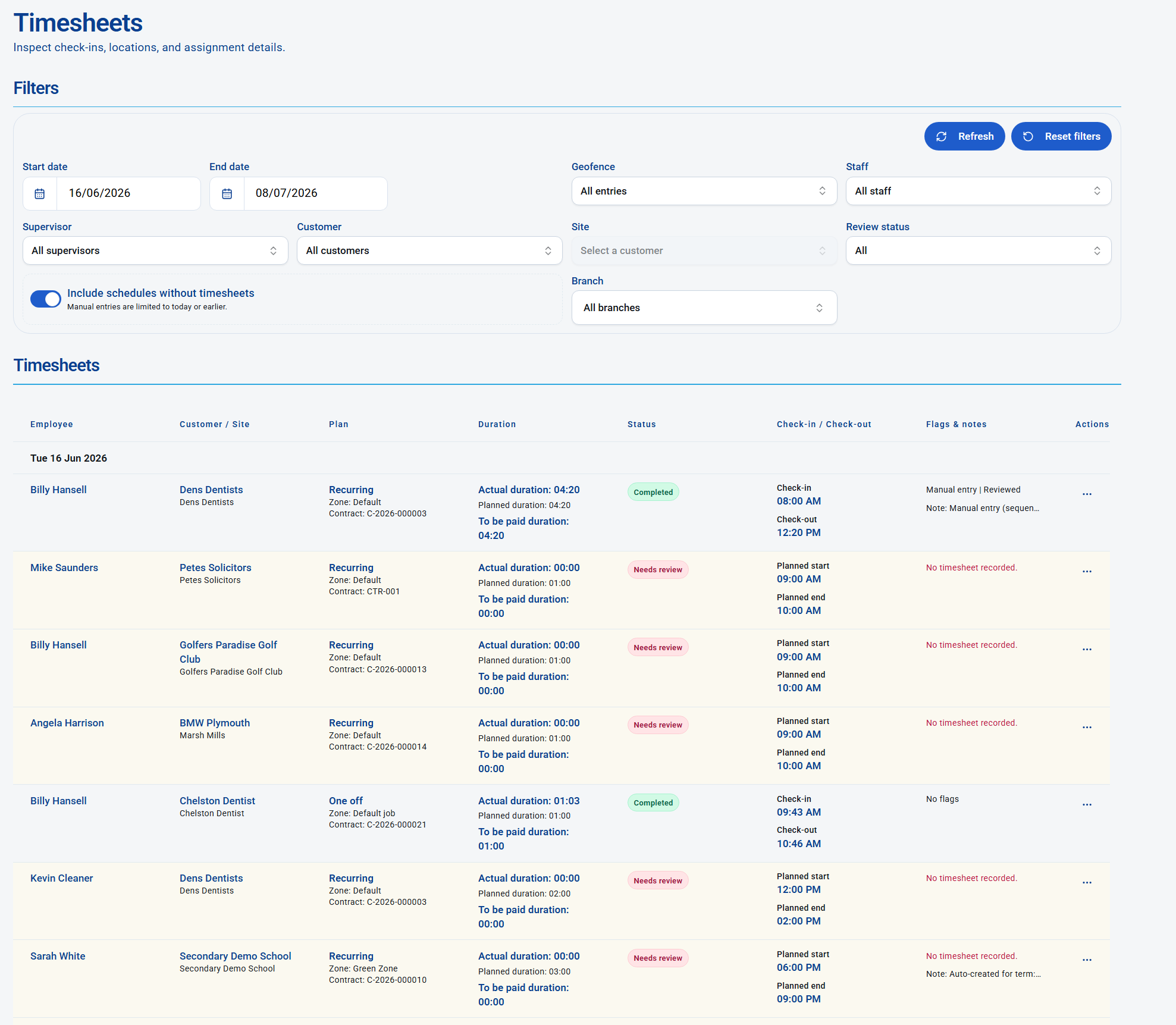
The important point is that every method should end in the same management process. Managers need one place to review late starts, missing check-outs, outside-geofence records, manual notes, cover cleaners, planned duration, actual duration and payroll-ready hours.
Today's plan shows the scheduled jobs, sites, staff and status before attendance evidence starts coming in.Timesheets brings attendance outcomes back into one review process, regardless of whether the check-in came from GPS, NFC, IVR or a reviewed exception.
How to choose the right attendance method
The strongest setup is not always the most technical one. The right method depends on the site, the cleaner, the customer, the mobile signal, the access route and the risk level of the contract.
GPS check-inBest for mobile-first teams, cover work, one-off jobs and sites where location evidence from a smartphone is practical.
GPS with enforced geofenceBest for sites where check-in should be blocked unless the cleaner is inside the approved boundary.
GPS with exception reviewBest for buildings where managers need location evidence but do not want legitimate attendance blocked by GPS drift or access differences.
NFC tagsBest for fixed customer sites where the business wants proof that the cleaner reached a specific point in the building.
IVR call-inBest for sites with a reliable fixed phone, limited mobile signal, restricted mobile use or staff who need a simple non-app option.
Manager reviewStill important when an exception needs human judgement, such as cover changes, access issues, signal problems or customer instructions.
What managers should see in the review process
Multiple check-in methods only help if the review process is clear. Managers should not have to open three different systems or reconcile several spreadsheets. The attendance evidence should feed into a single timesheet view where exceptions can be reviewed before payroll.
Which employee was assigned to the planned job.
Which site, customer and contract the attendance relates to.
Which method was used to check in or out.
Whether the check-in was inside or outside the geofence where GPS is used.
Whether the attendance looks complete, missing or in need of review.
Planned duration, actual duration and payable duration.
Notes, flags or manual entries explaining the exception.
Why breadth matters
Most cleaning companies have a mixed estate. One customer site may be perfect for enforced GPS geofencing. Another may need outside-geofence exception review because the practical entrance is not where the map expects it. Another may need NFC because the cleaner has to reach a particular room inside a large building. Another may still work best with an IVR landline call-in process.
A deep time and attendance solution needs enough breadth to support those real-world differences without creating separate admin processes. KleanFlo's approach is to support multiple attendance options, then bring the results back into the same operational workflow: schedules, today's plan, timesheets, exceptions, review status and payroll-ready hours.
Implementation checklist
Identify which sites should use GPS, enforced geofence, outside-geofence review, IVR landline call-in or NFC.
Set the correct geofence policy for each site rather than applying one rule everywhere.
Store known landline numbers against the right customer sites.
Supply NFC tags and fix them in agreed, practical locations on site.
Train staff on the expected check-in and check-out process for each site.
Explain what staff should do if GPS is inaccurate, access changes or a tag cannot be reached.
Review exceptions daily rather than waiting for payroll cut-off.
Use timesheet review to approve payable duration and investigate missing records.
Related KleanFlo pages
Time and attendance sits inside the wider cleaning operations workflow.
KleanFlo supports GPS-based check-in, configurable geofence rules, IVR landline call-in matched against known site numbers and NFC tags fixed on site.
Can KleanFlo enforce geofence check-ins?
Yes. KleanFlo can enforce a site geofence where stricter location control is needed, or allow outside-geofence check-ins and flag them for manager review.
Why allow check-ins outside the geofence?
Allowing outside-geofence check-ins can be useful where GPS accuracy varies, the practical entrance differs from the mapped address, staff work across a large site or the office would rather capture and review the exception than block the cleaner.
Why use NFC tags for cleaning attendance?
NFC tags can be fixed at the customer site so the cleaner must physically tap the tag to record attendance, giving a clear site-presence signal.
Does KleanFlo supply the NFC tags?
No. The cleaning company supplies its own NFC tags and fixes them at agreed locations on site. KleanFlo supports the attendance workflow that uses those tags.
Why use landline call-in?
Landline call-in is useful where a site has a known fixed phone number, mobile signal is poor, smartphone use is restricted or the business wants a non-app attendance option.
Can GPS, IVR and NFC records all feed timesheets?
Yes. The point is to capture attendance evidence in different ways, then review the outcome through one timesheet and payroll-hour process.
Need a deeper time and attendance setup?
Use KleanFlo to support GPS check-in, geofence rules, IVR landline call-in, NFC tags, timesheet review and payroll-ready attendance records.

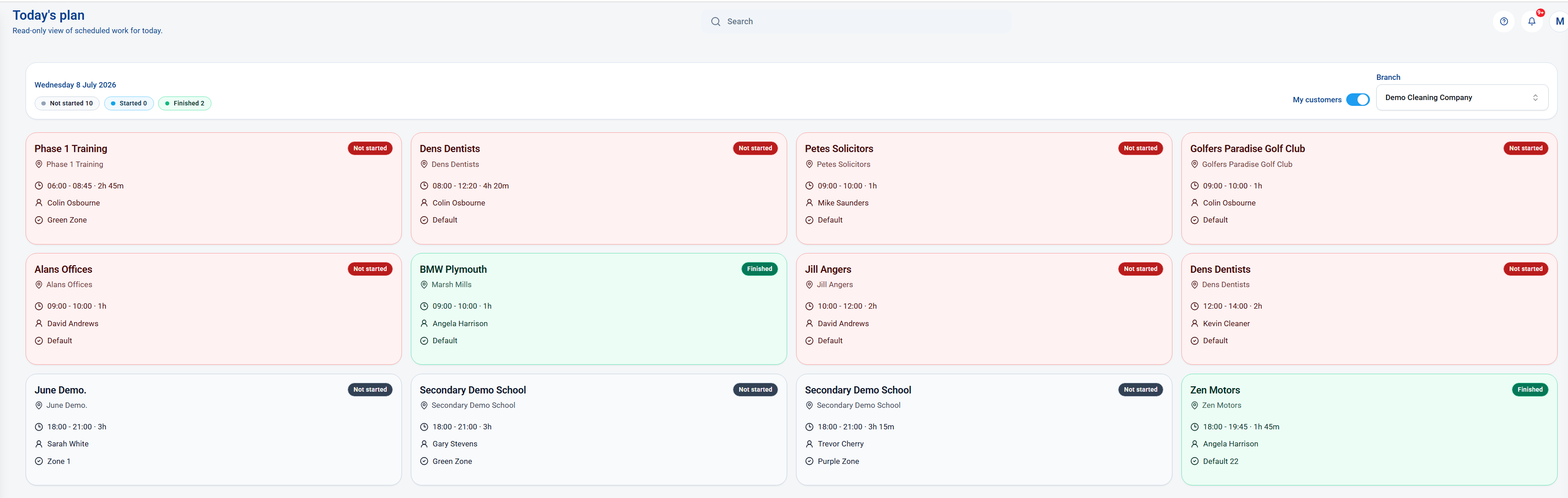 Today's plan shows the scheduled jobs, sites, staff and status before attendance evidence starts coming in.