The payroll problem
School cleaning is not a normal 52-week contract
In an office cleaning contract, the same cleaner might work the same number of hours every week. School cleaning is different. The regular service usually follows term dates, but deep cleans, floor work, classroom resets and other non-term work may happen during school holidays.
That creates a payroll and planning question: how do you fairly record the whole year when the employee does not work the same pattern every week?
Annualised hours are one way of dealing with that pattern. Instead of only looking at a single week, the business looks at the agreed annual position: term-time hours, non-term hours, holiday hours, salary basis and any extra hours that need to be reviewed.
Annualised hours only work well when the schedule, school calendar, non-term work and salary records all agree with each other.
What are annualised hours?
Annualised hours are an agreed number of hours across a year. The employee may work different hours at different points in the year, but the overall annual position is used to understand what they should be paid and what has been worked.
For school cleaning companies, that usually means looking at:
- Regular term-time cleaning hours.
- Additional non-term hours for holiday work or deep cleans.
- Holiday entitlement and holiday pay records.
- Salary basis where the employee is paid evenly across the year.
- Any extra hours, changes or exceptions during the year.
The point is not to make payroll more complicated. The point is to create a clear year-round record for a contract that does not behave like a standard weekly rota.
Why schools use this approach
Schools often need predictable service during term time and extra work during school holidays. Staff may prefer steady pay across the year, while the cleaning company needs to make sure the hours and salary position still make sense.
That is why some school cleaning roles are set up with a salary or annualised-hours approach. The employee might do fewer weeks of regular term-time work than a standard 52-week role, but the annual picture also includes agreed school holiday work and holiday entitlement.
Do school cleaners work in the holidays?
Some school cleaners work during school holidays and others do not. It depends on the employment contract and the cleaning specification. Holiday periods may include deep cleans, floor care, classroom resets and preparation before pupils return. These non-term hours should be planned separately from the regular term-time rota. See the practical guide to planning school holiday deep cleans.
Do school cleaners get paid during school holidays?
Payment depends on the employee's contract and pay arrangement. Some term-time cleaners are paid only for contracted working weeks plus holiday entitlement; others receive an annualised salary spread evenly across the year. Cleaning companies should document term hours, non-term work, holiday entitlement and salary calculations clearly, and take payroll or employment-law advice where needed.
Where cleaning companies struggle
The challenge is not the idea of annualised hours. The challenge is keeping the records together. The term dates may be in one spreadsheet, the staff rota in another, school holiday work in emails and salary checks somewhere else.
That is when the office team starts asking difficult questions:
- Have we calculated the contracted hours from the right term dates?
- Were the agreed non-term hours actually booked?
- Did the employee work extra hours during a school holiday?
- Are holiday hours visible against the salary calculation?
- Has the staff member started or left part way through the year?
- Is the monthly salary still aligned with the annual position?
Example: term hours plus holiday work
A school cleaner works two hours per day, Monday to Friday, during term time. The school also needs extra work during the holidays for deep cleaning and return-to-school preparation. If those hours are handled in separate spreadsheets, it is easy to lose track of what has been contracted, booked and delivered.
When term hours, non-term hours and salary details are held together, the office team can see the full academic-year position instead of trying to rebuild it at payroll review time.
KleanFlo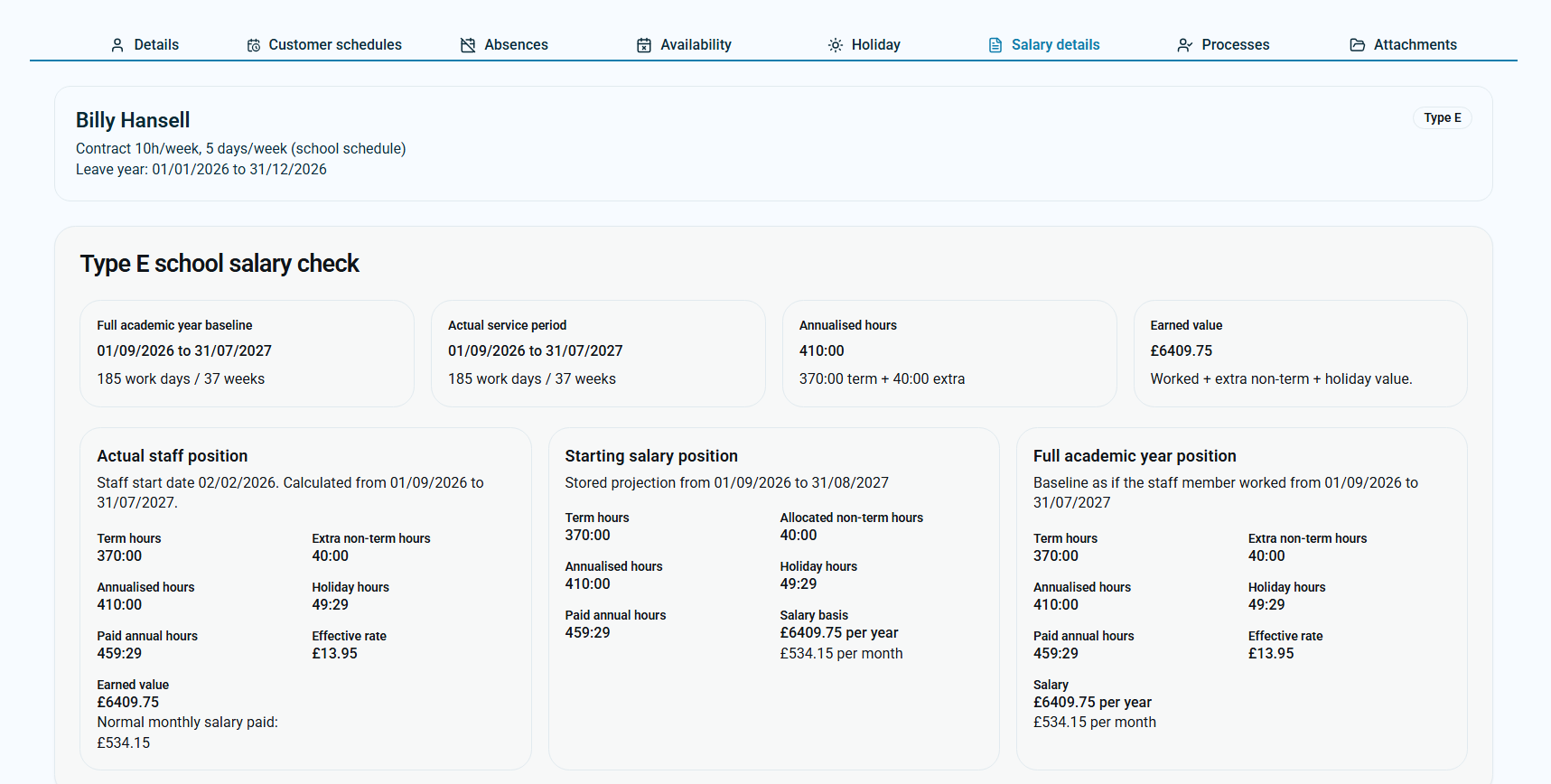 Salary details can show term hours, extra non-term hours, annualised hours, holiday hours, salary basis and earned value.
Common annualised-hours mistakes
Most mistakes come from treating a school cleaning contract like a normal weekly pattern. Common issues include:
- Treating every week equally when the contract follows term dates.
- Losing track of holiday hours or salary assumptions.
- Using separate spreadsheets for schedules, payroll and availability.
- Forgetting contracted non-term work during school holidays.
- Failing to review the position when staff start or leave mid-year.
- Not recording extra hours clearly enough for payroll review.
These mistakes are avoidable, but only if the business keeps one reliable view of the academic year.
Best-practice checklist
A good annualised-hours process should make the annual position easy to audit. At a minimum, cleaning companies should:
- Record contracted weekly hours and the academic year dates.
- Separate term-time work from non-term work.
- Track contracted, booked and delivered non-term hours.
- Record staff availability for school holiday work.
- Review salary, holiday and annualised hours regularly.
- Keep one source of truth for schedules, staff records and salary checks.
Step 1: Start with the term dates
The annualised-hours calculation depends on the academic year. If the term dates are wrong, the schedule and salary check will be wrong too.
This is why Guide 1 in this series focuses on how to schedule school cleaners around term dates. The term calendar is the foundation for the whole school cleaning year.
KleanFlo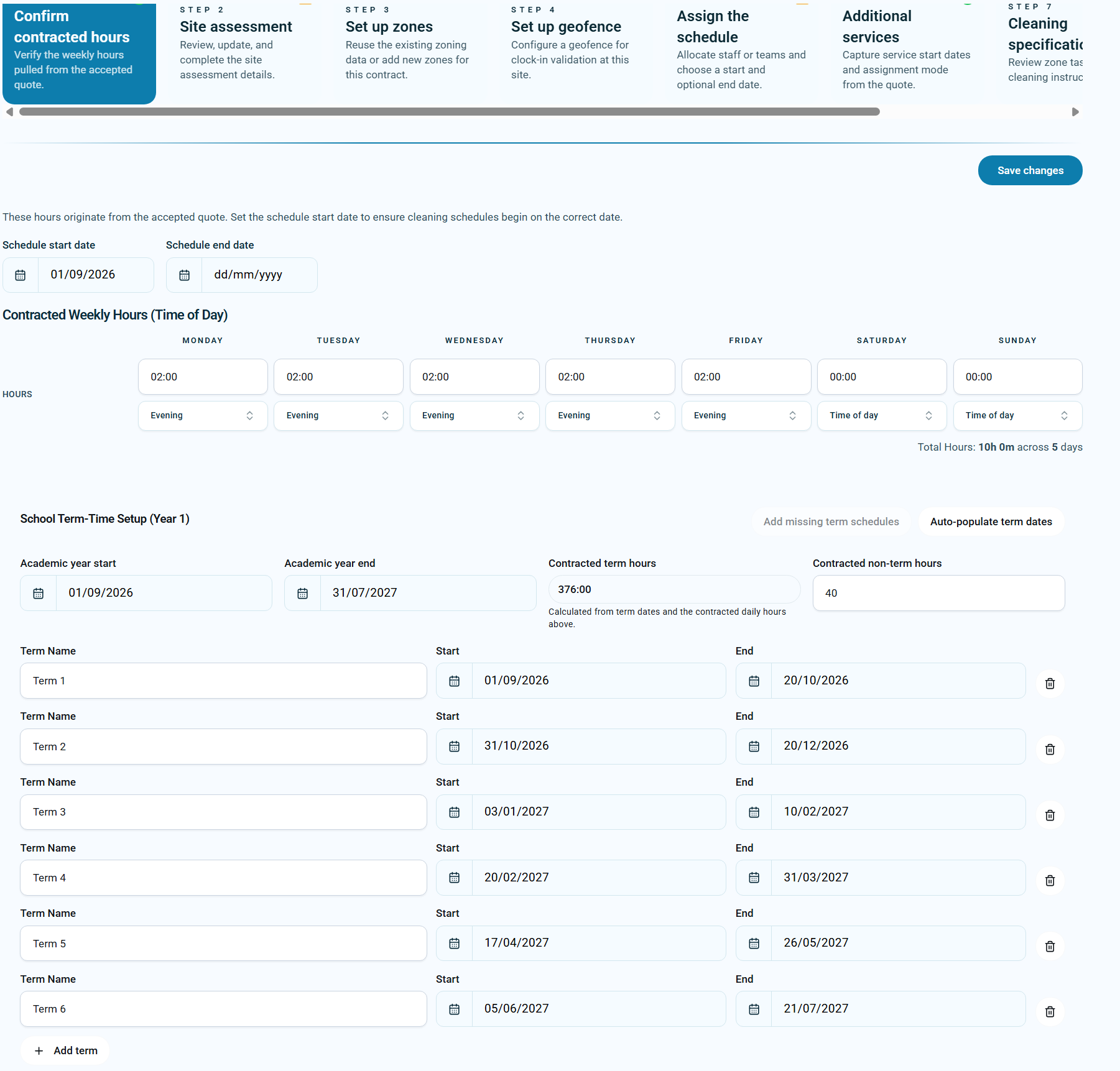 Term dates provide the academic-year structure behind the school schedule and annual hours position.
Step 2: Track non-term hours separately
School holiday work should not disappear into the normal rota. Deep cleans and other non-term work need to be tracked against the school contract so the business can see what has been contracted, booked, delivered and remaining.
Guide 2 explains how to plan school holiday deep cleans. From a payroll perspective, the important point is that those hours need to stay connected to the staff and contract records.
KleanFlo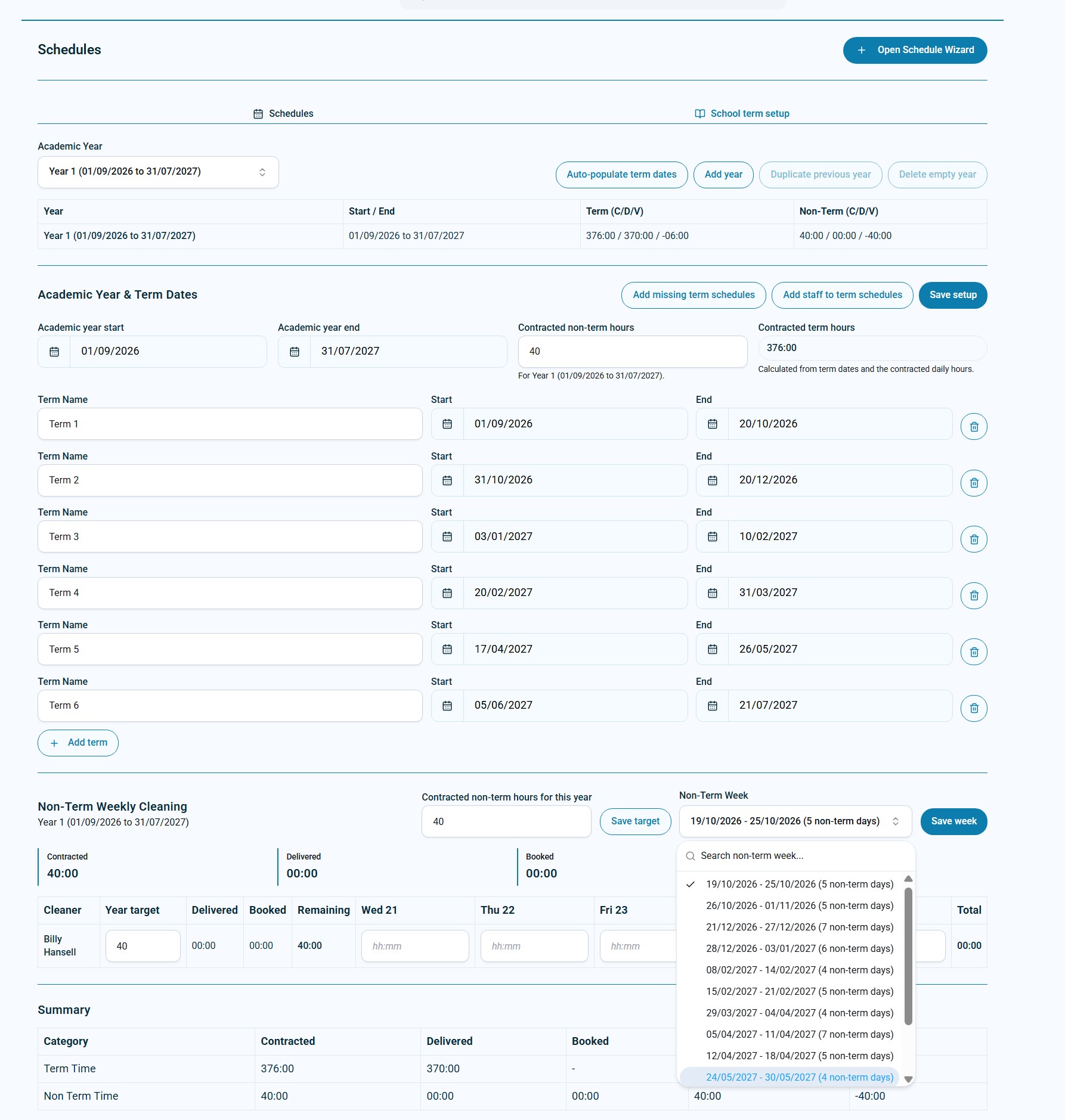 Non-term hours should be tracked separately from regular term-time cleaning so the annual position remains clear.
Step 3: Record availability before booking holiday work
School cleaners may not be taking holiday, but they may still be unavailable for certain school holiday dates. That information matters for planning, but it should not automatically be treated as annual leave.
Keeping availability separate helps the office team plan school holiday work without confusing payroll holiday records.
KleanFlo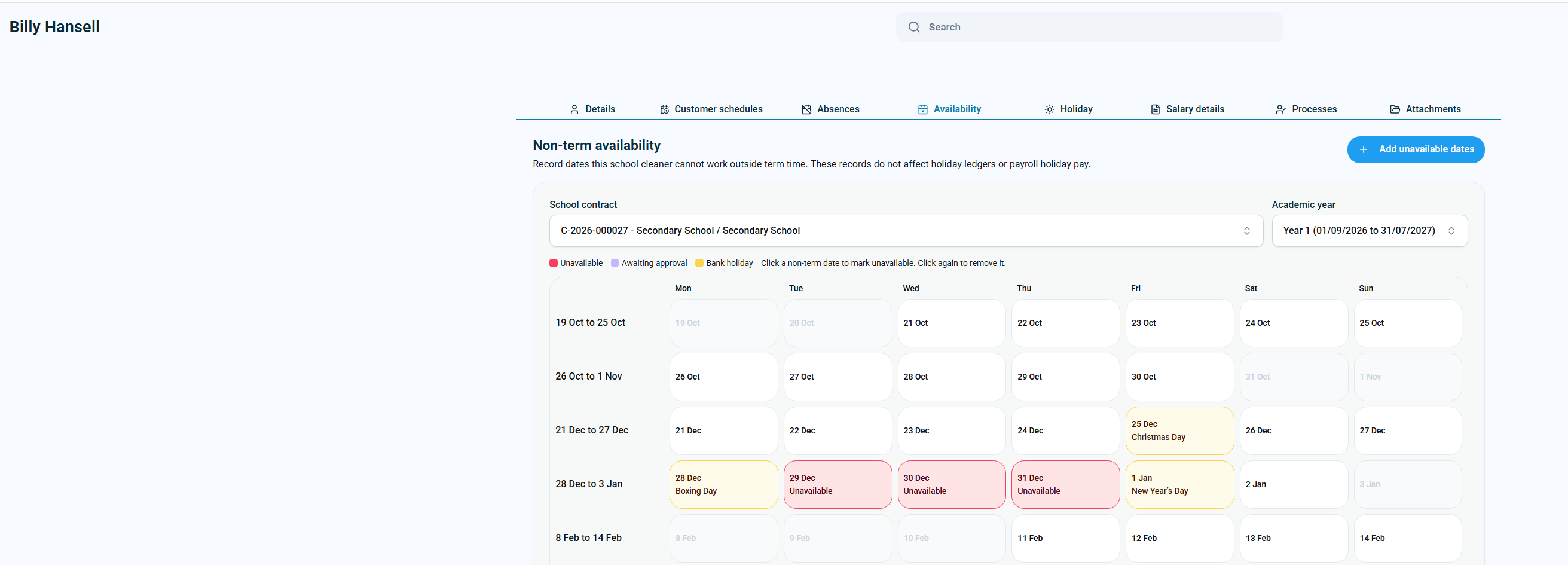 Staff unavailable dates support school holiday planning without being treated as holiday absence.
Step 4: Review the salary position
Once term hours, non-term hours and staff records are in place, the salary position can be reviewed. The office team needs to understand term hours, allocated non-term hours, annualised hours, holiday hours, effective rate, salary basis and earned value.
KleanFlo can show these records together so the business is not reconstructing the annual position from disconnected spreadsheets.
Compliance note
Annualised-hours and salaried-hours arrangements need to be handled carefully. GOV.UK explains that annualised hours can be treated as worked evenly through the year for salaried-hours work, but employers still need to check the worker's equivalent hourly rate for National Minimum Wage purposes. GOV.UK also states that most workers are entitled to 5.6 weeks' paid holiday a year.
This guide is operational guidance, not legal advice. Cleaning companies should check their own contracts, payroll process and employment advice before changing how staff are paid.
Where KleanFlo fits
This is where KleanFlo school cleaning software fits naturally. KleanFlo connects term dates, customer schedules, non-term work, staff availability and salary details in one operating system.
Instead of calculating school cleaner salary and annualised hours from separate spreadsheets, the office team can review the records that sit behind the contract: planned term schedules, booked out-of-term hours, staff availability and salary checks.
