The planning problem
School holiday deep cleans need more than a date in the diary
A school holiday deep clean is often treated as a separate task, but operationally it touches several parts of the cleaning business. The office needs to know when the school is closed, what work has been promised, which staff are available, how many contracted non-term hours are included, and whether the same team is already committed somewhere else.
For many cleaning companies, the busiest planning point is the summer break. Schools expect classrooms, corridors, toilets and specialist areas to be ready for September. At the same time, the cleaning company may still be running office contracts, holiday cover, periodic work and other school deep cleans.
This is why school holiday deep-clean planning should not live in a separate spreadsheet. It needs to sit alongside regular cleaning schedules, staff records and contract hours.
The best deep-clean plan starts with the school holiday window, then checks scope, staffing, contracted hours and existing commitments before any work is booked.
Why schools need deep cleans
Term-time cleaning is usually focused on daily standards: keeping classrooms usable, toilets clean, bins emptied, touchpoints maintained and communal areas presentable. A school holiday deep clean gives the cleaning team time to deal with work that is difficult, disruptive or impractical while staff and pupils are on site.
Deep cleans are also an important part of customer confidence. A school leadership team wants to know that the building has been properly prepared before pupils return. When the work is planned clearly, the cleaning company can show what was scheduled, who completed it and where the hours were used.
What work is usually completed?
The exact specification depends on the contract, but school holiday and school summer deep cleans often include:
- Carpet cleaning and spot treatment.
- Floor stripping, polishing and sealing.
- High-level dusting in classrooms, halls and corridors.
- Kitchen deep cleans and food preparation areas.
- Toilets, washrooms and changing rooms.
- Internal windows, glazing and partitions.
- IT rooms, libraries and specialist teaching spaces.
- Furniture moves, classroom resets and return-to-school preparation.
Some of this work may be included in the annual school cleaning contract. Some may be quoted separately. Either way, the office team needs a clear plan before the holiday window starts.
The traditional way
The manual process usually starts with a spreadsheet, a school calendar and a list of tasks. Managers look at the summer holidays, decide which weeks are available, ask staff if they can work, then build a rough plan around who is free.
That can work when there is one school and a small team. It becomes much harder when the company manages several schools, multiple supervisors and cleaners who also work on regular commercial contracts. If you are planning the next academic rota as well as the holiday work, it is worth reading our guide to how to schedule school cleaners around term dates.
Example summer deep-clean timeline
A simple timeline helps the office team move the work out of the last-minute rush. The exact dates will change by contract, but the planning rhythm is usually similar.
Time before holidaysAction
8 weeksConfirm school holiday dates, access restrictions and any building works.
6 weeksConfirm staff availability and supervisor cover.
5 weeksConfirm the deep-clean scope, floor-care requirements and any specialist work needed.
4 weeksBook deep-clean teams into the customer schedule for the correct non-term weeks.
2 weeksConfirm keys, alarm details, site access and customer expectations.
During holidaysMonitor progress daily and adjust cover quickly if staff availability changes.
Final weekComplete snagging before the school reopens.
Where mistakes happen
Deep-clean planning tends to fail in predictable places:
- Staff are booked for school holiday work even though they already have regular shifts.
- Unavailable dates are captured in messages but not shown in the plan.
- Contracted non-term hours are not tracked against booked work.
- Work is planned for a week when the school has restricted access.
- Out-of-term hours are planned away from the customer schedule and never tied back to the school contract.
- Supervisors are not given enough notice of what needs to happen.
None of these issues are unusual. They happen because the plan is split across spreadsheets, messages, calendars and memory.
Common mistakes when planning school holiday deep cleans
The strongest plans usually avoid the same common mistakes:
- Leaving staffing decisions until the last minute.
- Treating holiday availability as annual leave.
- Booking every deep clean into the first week of summer.
- Forgetting access restrictions, building work or contractor dates.
- Not allowing time for snagging before pupils return.
- Using separate spreadsheets for staffing, schedules and contracted hours.
Once holiday work has been planned, it is also worth reviewing your wider commercial cleaning scheduling process. The same staff and supervisors may still be needed on offices, communal areas, retail sites or other regular contracts while the school work is taking place.
Example: the summer holiday squeeze
A cleaning company manages 12 school sites and needs to complete summer deep cleans across a six-week holiday period. Some cleaners can only work the first two weeks, one supervisor is unavailable in August, and two schools have building work planned before the new term.
If the office team plans that work manually, it is easy to double-book staff or miss part of the contracted non-term hours. With the school holiday weeks, unavailable dates and booked work visible together, the team can build a plan that is realistic before anyone is sent to site.
A better approach
Experienced cleaning companies treat school holiday deep cleans as planned operational work, not as an afterthought. A better process is:
- Confirm the school holiday dates and access restrictions.
- Separate regular term-time cleaning from non-term work.
- Confirm the deep-clean specification and any quoted extras.
- Check the contracted non-term hours for each school.
- Record which staff are unavailable during the holiday period.
- Book the work into specific school holiday weeks.
- Make sure supervisors and staff can see what has been assigned.
- Review what was booked, completed and still remaining.
That turns school holiday cleaning from a last-minute rush into a controlled planning exercise.
Step 1: Start with the school holiday window
The first question is not which cleaner is free. The first question is when the school is available. Some schools may have contractors on site, inset days, partial closures or restricted access during the holidays. Those dates need to shape the plan.
If the term dates are already held against the school contract, the non-term weeks can be used as the planning window for deep-clean work. This is why the term-date setup process matters before the deep-clean planning starts.
KleanFlo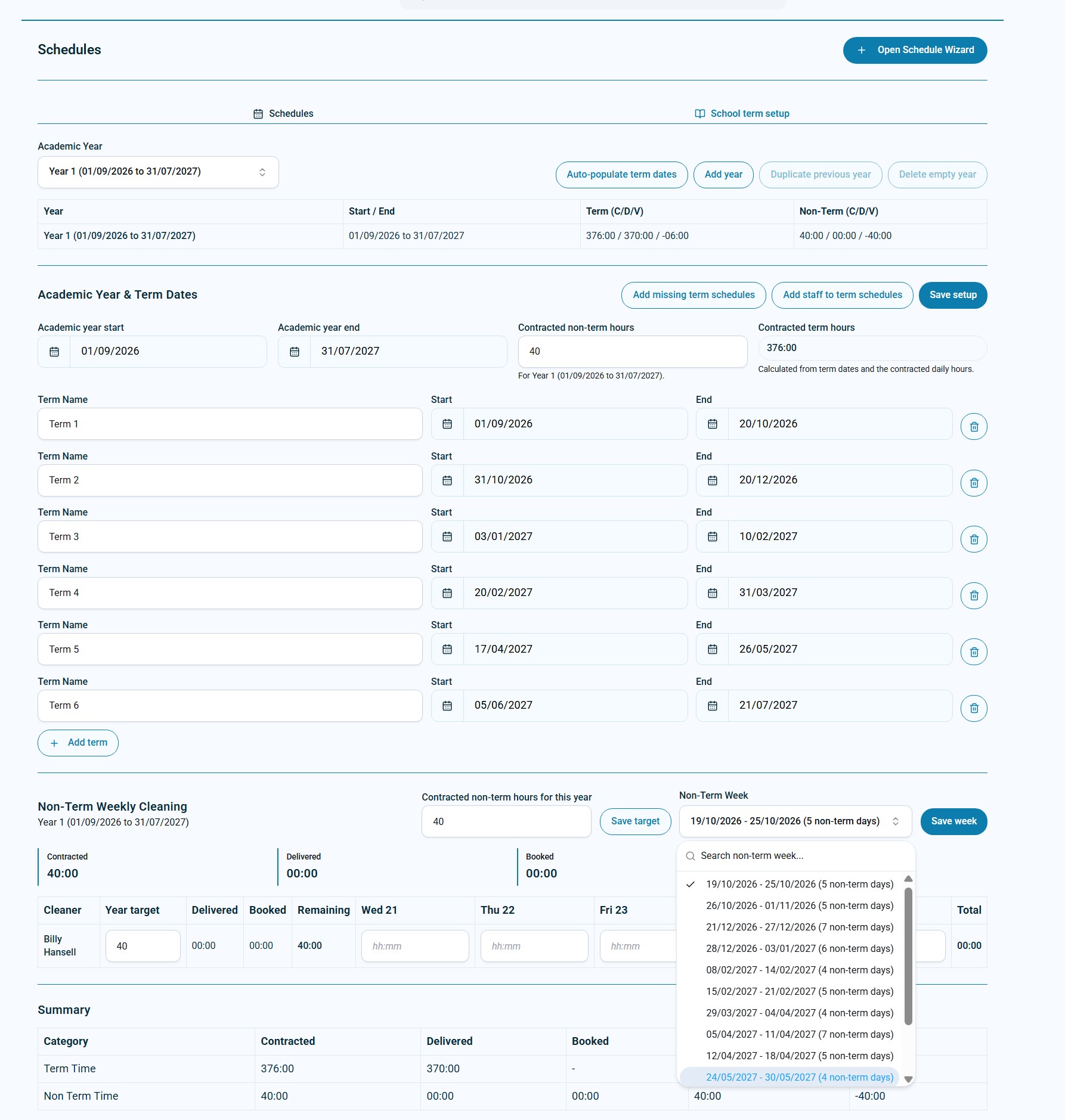 Non-term weeks give the office team a clearer planning window for school holiday deep cleans.
Step 2: Track contracted hours before booking work
Many school contracts include an agreed amount of non-term cleaning. That might be expressed as annual hours, holiday hours, deep-clean hours or extra work outside term time.
Those hours should be visible before the office starts booking staff. If the team cannot see what has been contracted, what has already been delivered and what remains, it becomes difficult to know whether the plan is still within the contract.
Step 3: Check staff availability
School holiday availability is not the same as holiday absence. A cleaner may not be taking paid holiday, but they may still be unavailable for deep-clean work during certain weeks. Recording that information separately helps the office plan without confusing payroll or holiday records.
KleanFlo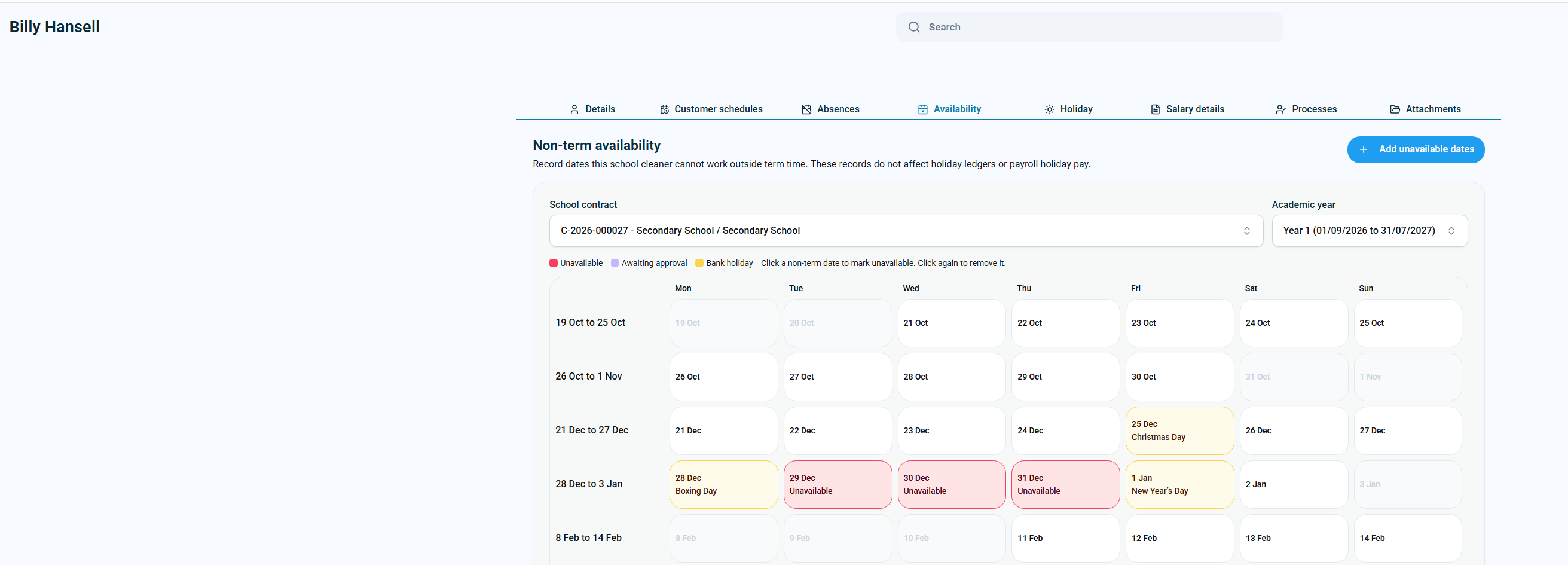 Staff unavailable dates can support school holiday planning without being treated as holiday absence.
Step 4: Book staff into the customer schedule
For contracted out-of-term hours, KleanFlo does not need the office to create a separate job record. The staff member is booked from the customer schedule page against the selected non-term week, and KleanFlo creates the out-of-term schedule automatically.
This keeps the booked hours connected to the school contract, the cleaner, the non-term target and the wider schedule. The office can see what has been contracted, delivered, booked and remaining without rebuilding the same work somewhere else.
KleanFlo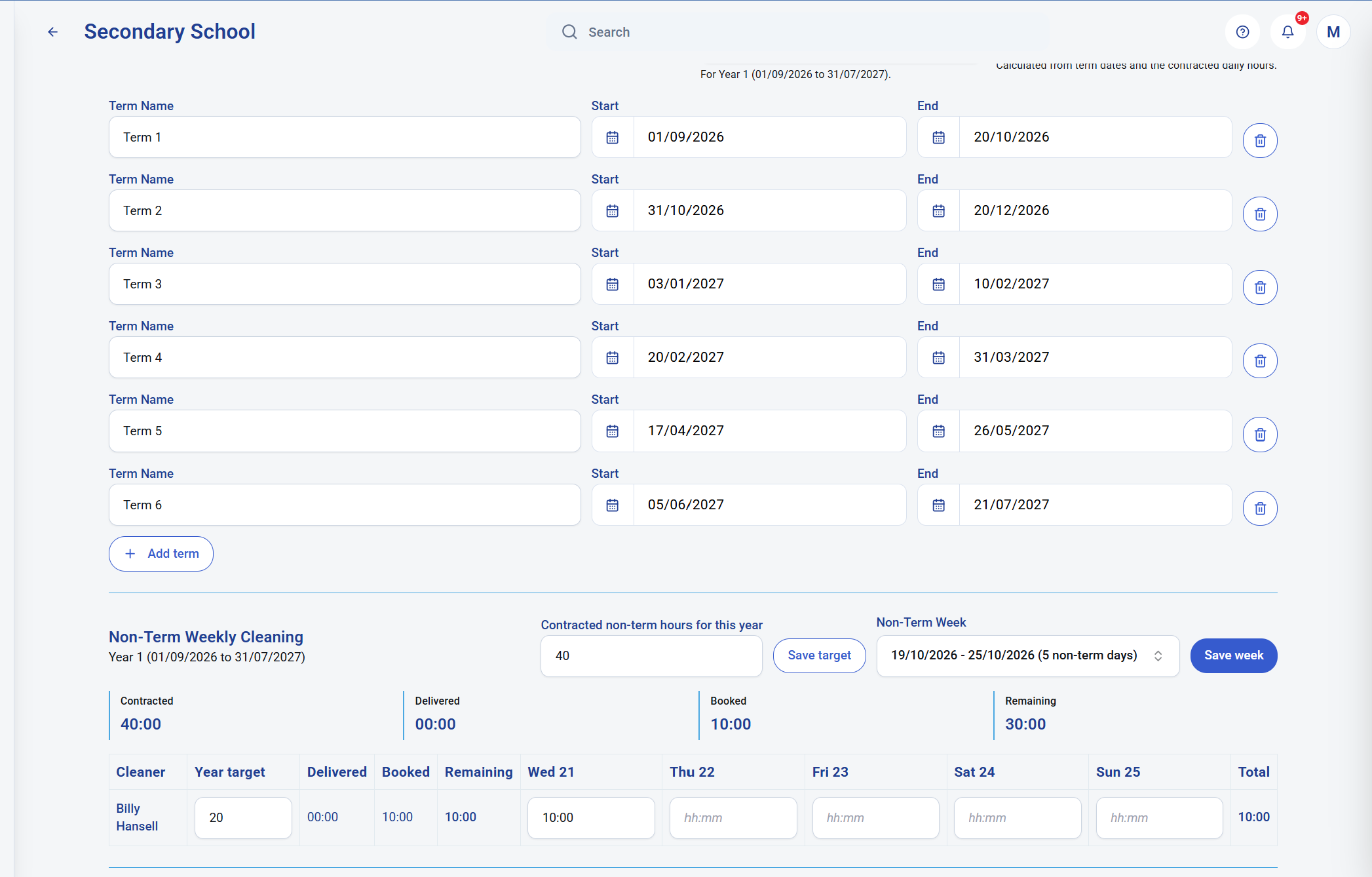 Staff are booked from the customer schedule page and KleanFlo creates the out-of-term schedule automatically.
Step 5: Keep supervisors informed
A deep clean usually needs more instruction than a normal daily visit. Supervisors may need to know which areas are prioritised, what equipment is required, whether floors need drying time, whether furniture needs moving and whether the school has access restrictions.
When the plan is held in the customer schedule, supervisors and office teams can see the booked holiday work in the right place. As the scheduled dates approach, the work can then appear in the relevant staff schedule without relying on separate emails, messages or printed sheets.
Where KleanFlo fits
This is where KleanFlo school cleaning software fits naturally. School holiday deep cleans sit between term dates, staff availability, customer schedules and contract-hour tracking. Those records should work together.
KleanFlo can help cleaning companies plan around school term dates, track contracted non-term hours, record staff unavailable dates, book staff into the customer schedule and automatically create out-of-term schedules. That gives the office team a clearer view before the holiday period starts.
Quick checklist for school holiday deep cleans
- Confirm the school holiday dates and access restrictions.
- Agree the deep-clean scope before scheduling staff.
- Separate term-time cleaning from non-term work.
- Check contracted non-term hours before booking work.
- Record staff unavailable dates for the holiday period.
- Book staff from the customer schedule page for contracted out-of-term hours.
- Check regular contracts before assigning staff to deep cleans.
- Make sure supervisors and staff can see the final plan.
Free download
School Holiday Deep Clean Planning Checklist
Use this one-page checklist before the Christmas, Easter or summer break to confirm dates, staffing, access, contracted hours and final snagging.
Download PDF
