
What the prospect is really looking for
Most commercial cleaning quotes are not multi-million pound boardroom pitches. They are practical buying decisions made by office managers, business owners, practice managers, school staff, facilities teams or site managers who want fewer cleaning problems.
That means your preparation should show three things quickly: you are reliable, you understand their site, and you can turn what you see into a clear cleaning specification and price.
The visit is your chance to prove how you will behave after the contract starts. If you arrive late, cannot find parking, forget the contact's name or ask questions already answered on their website, the prospect may assume the same looseness will appear in the cleaning service.
Research the business before you leave
Spend ten minutes understanding who you are visiting. Look at the prospect's website, Google Business Profile, LinkedIn page if relevant, and any public photos of the premises. You are not trying to become an expert in their business. You are trying to avoid walking in cold.
- Confirm the business name, site address, contact name and contact role.
- Check what type of premises it is: office, medical site, showroom, school, leisure site, warehouse, retail unit or managed building.
- Look for opening hours, visitor instructions, reception arrangements and parking information.
- Notice any sector-specific cleaning concerns, such as washroom traffic, food areas, customer-facing spaces, infection control expectations or security restrictions.
- Check whether they have multiple locations, because the first quote may lead to wider work if the relationship starts well.
Plan the route properly
Use Google Maps before the visit, not when you are already late. Check the route at the same time of day as the appointment if possible, because morning traffic, school runs, industrial estate congestion and town-centre parking can change the journey time completely.
Look at Street View so you know what the building entrance looks like. If the site is in a business park, hospital estate, school campus or shared building, check which entrance is likely to be used by visitors. If parking is unclear, call or email ahead and ask where contractors should park.
Aim to be parked and ready at least ten minutes early. Do not walk into reception twenty minutes early and create pressure for the prospect. Use that time to review your notes, silence your phone and get your survey checklist ready.
Dress for the contract you are quoting
You do not need to look like you are pitching a corporate finance deal. You do need to look clean, organised and appropriate for the site.
For many commercial cleaning quote visits, branded clothing is the strongest choice: a clean branded polo, softshell, fleece or jacket with smart trousers and clean shoes. It signals that you are a working cleaning business, not just a salesperson. For more formal settings, such as larger facilities management meetings, property management offices or tender presentations, step the clothing up without losing practicality.
- Wear clean branded clothing where it fits the customer and site.
- Avoid heavy fragrance, dirty footwear, crumpled clothing or anything that looks careless.
- Take PPE if the site may require it, such as safety shoes, high-vis, gloves or eye protection.
- Keep a tidy notebook, tablet or survey form ready instead of loose scraps of paper.
- Make sure your vehicle and any visible equipment do not undermine the professional impression.
Prepare your quote visit checklist
The purpose of the walkthrough is to collect enough detail to price accurately and avoid scope disputes later. Do not rely on memory. Use a repeatable checklist and capture notes while you are on site.
- Areas to clean, including offices, washrooms, kitchens, reception areas, stairs, lifts, corridors, meeting rooms, production areas and external entrances.
- Cleaning frequency by area, including daily, weekly, monthly and periodic work.
- Current cleaning problems, complaints, priorities and any areas the prospect is particularly sensitive about.
- Access times, alarm process, keys, fobs, signing-in requirements and lone-working considerations.
- Consumables, waste, sanitary services, recycling arrangements and who supplies what.
- Floor types, specialist surfaces, high-touch points, glass, carpets, kitchens and washroom standards.
- Staffing constraints, preferred cleaning times, security rules and whether work must happen around employees, pupils, patients or visitors.
- Reporting expectations, audit frequency, customer contact process and how issues should be escalated.
Ask questions that show operational understanding
Prospects often start by asking for a price. A stronger contractor slows the process down enough to understand the service. Good questions show that you are thinking about the cleaning contract as a working operation, not just a square-metre calculation.
- What is working well with the current cleaning arrangement?
- What needs to improve?
- Which areas receive the most complaints or attention?
- Are there busy periods, quiet periods or seasonal changes we should plan around?
- Who signs off standards, receives reports and raises service issues?
- Are there security, safeguarding, health and safety or site induction requirements?
- What would make the first 30 days of the new contract feel successful?
Take useful evidence, with permission
Photos, measurements and notes help you produce a cleaner proposal, but ask before taking photos. Some sites have confidentiality, safeguarding or security restrictions. If photos are allowed, capture practical evidence: floor type, washroom layout, access points, storage areas, problem zones and periodic cleaning requirements.
Do not turn the visit into a photography exercise. The prospect should feel listened to. Use evidence to support the quote, build the cleaning specification and brief the team if the contract is won.
Follow up while the visit is still fresh
The best impression can be lost by a slow or vague follow-up. Send a short confirmation after the visit, thank them for their time, summarise what you understood and confirm when the written quote will arrive.
Your quote should reflect the site you actually saw. Include the proposed cleaning frequency, scope, assumptions, exclusions, consumables position, mobilisation notes and next steps. Where relevant, include how you will prove attendance, complete audits, report issues and communicate with the customer after the contract starts.
Simple pre-visit checklist
- Appointment confirmed, including contact name, phone number and exact address.
- Google Maps route checked, parking checked and realistic travel buffer added.
- Prospect website and public business information reviewed.
- Clean branded clothing or suitable professional clothing ready.
- Survey checklist, notebook, tablet, charger and pen ready.
- PPE, ID, business cards or company information ready if needed.
- Previous notes, enquiry details and known requirements reviewed.
- Follow-up time blocked so the quote is not delayed by normal daily work.
Where KleanFlo fits
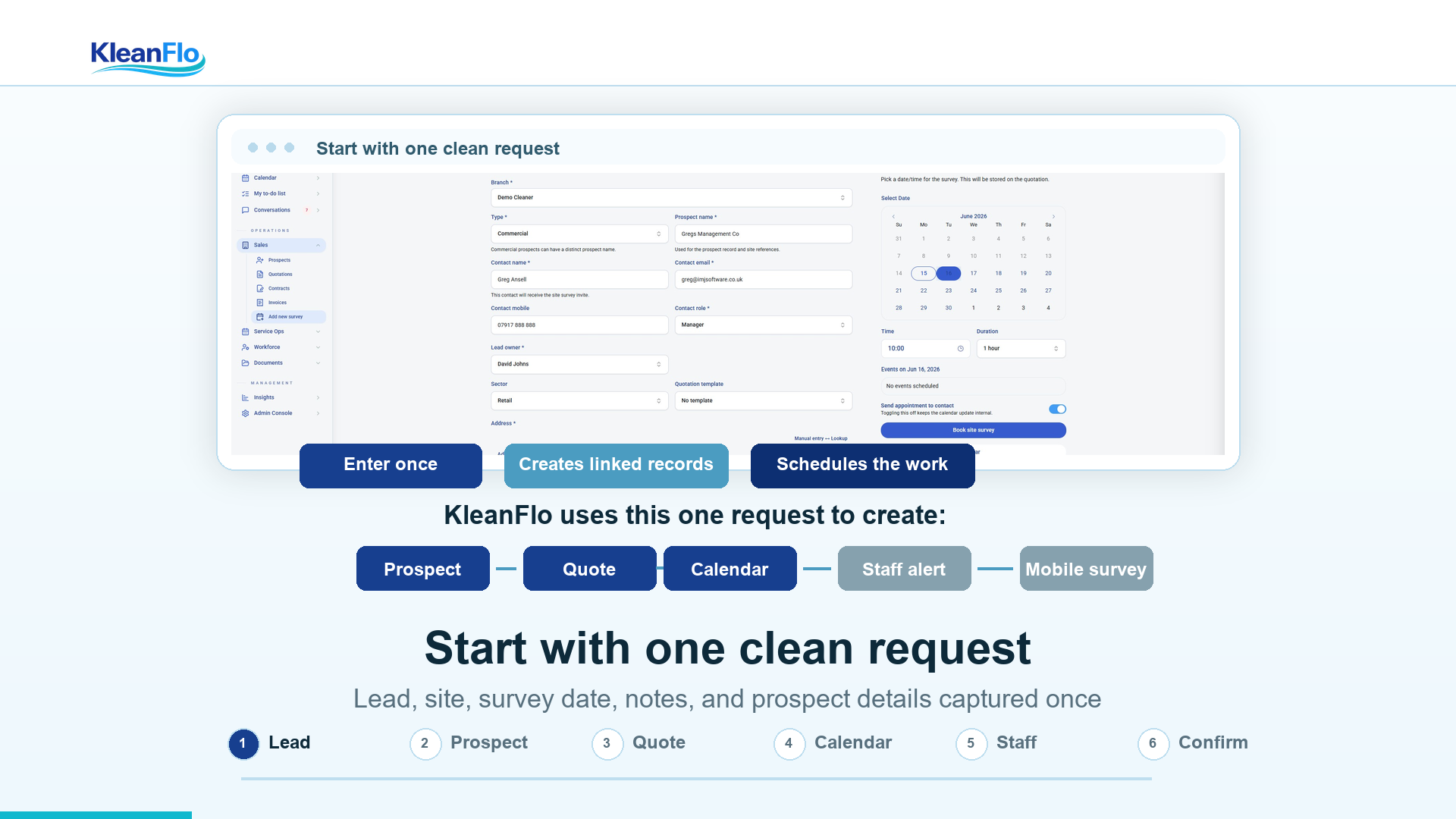
KleanFlo cleaning quotation software helps cleaning companies keep the sales process connected from the first enquiry through to survey, quote and contract setup.
Instead of keeping prospect notes, survey dates, site details and quote records in different places, KleanFlo helps teams capture the information once and keep it visible as the opportunity moves forward.