Why onboarding matters
Cleaning companies need onboarding records because issues rarely happen at convenient times
Cleaning work often happens early in the morning, late at night, at customer premises and away from the office. A new cleaner may be alone on site, using chemicals, handling keys, following customer security rules, working around members of the public, or cleaning areas with different risk levels. That makes onboarding a control process, not just an HR formality.
The objective is simple: by the time the cleaner starts work, the business should know that the right checks, documents, training, site instructions and communication routes are in place. If something goes wrong later, the company should be able to see what was issued, what was explained, what was acknowledged and what follow-up happened.
Good onboarding helps protect the employee, the customer, the supervisor and the cleaning business. It creates a record before the first shift, not after the first complaint.
Examples of where onboarding records help later
Customer complaintIf a customer says a task was missed, onboarding records can show whether the cleaner received the specification, site notes and expected standard.
Health and safety incidentIf there is an accident, the business may need to show that relevant risk information, COSHH guidance, PPE expectations and reporting routes were covered.
Attendance disputeIf hours are queried, onboarding should show the employee understood shift times, check-in requirements and time and attendance expectations.
Conduct issueIf there is a customer-site behaviour concern, induction records can show which policies, site rules and escalation routes were explained.
Safeguarding or regulated siteFor schools, care settings or other sensitive environments, the business may need evidence that relevant checks, site restrictions and reporting expectations were handled.
What a standard cleaning staff onboarding process should include
There is no single onboarding process that fits every cleaning company. A small residential team, a school cleaning contractor, a healthcare cleaning provider and a multi-site commercial contractor will all need different levels of control. The structure below is a practical baseline that can be adapted by role, customer, site and risk level.
1. Pre-start checks and employment setup
Before a cleaner starts work, the business should complete the core employment setup. In the UK, employers need to check a worker's right to work before employment begins. Payroll information also needs to be gathered so the employee can be set up correctly for PAYE where applicable.
- Confirm role, start date, work location or contract area.
- Complete the required right-to-work process before employment starts.
- Collect payroll starter information, bank details and emergency contact information.
- Confirm agreed hours, pay arrangements, reporting line and probation or review process.
- Identify whether a DBS check or customer-specific clearance is needed before site access.
2. Contract, policies and document acknowledgement
The employee should understand the documents that govern the role. That may include the employment contract or worker agreement, handbook, absence policy, holiday process, uniform policy, mobile phone policy, lone working process, health and safety policy, data protection expectations and customer-site rules.
This is where records matter. If documents are issued informally and no acknowledgement is captured, it is harder to prove later that the employee received or understood the requirement. Cleaning companies should create a repeatable way to send, explain and record acknowledgement of key documents.
3. Health and safety induction
Cleaning work can involve chemicals, manual handling, slips and trips, lone working, sharps, biological contamination, working around the public, and site-specific hazards. The health and safety induction should be proportionate to the role and site, but it should not be skipped just because the cleaner is experienced.
- Explain accident, incident and near-miss reporting.
- Cover relevant risk assessments, method statements and safe systems of work.
- Explain COSHH information for cleaning chemicals used by the employee.
- Confirm PPE requirements and when PPE must be worn.
- Cover manual handling, slips and trips, electrical safety and equipment use where relevant.
- Explain lone working or out-of-hours procedures if the cleaner may work alone.
4. Site induction and customer-specific expectations
A cleaner can understand the company policy and still fail on a customer site if the site-specific detail is missing. Site induction should explain the practical information needed to complete the work safely and consistently.
AAccess
Keys, alarms, codes, entry routes, signing-in requirements, restricted areas and who to contact if access fails.
SSpecification
Cleaning tasks, frequencies, standards, priority areas, customer expectations and any areas that need extra care.
HHazards
Site-specific risks, waste handling, chemicals, equipment, lone working, parking, lighting and emergency arrangements.
EEscalation
Who the cleaner should contact for access issues, customer concerns, incidents, absence, equipment failure or urgent instructions.
5. Equipment, uniform, keys and system access
Onboarding should make practical readiness visible. If the cleaner does not have uniform, PPE, keys, alarm instructions, mobile access or the correct site documents, the first shift is already at risk.
A simple readiness check can prevent avoidable problems: employee record complete, documents issued, site assigned, schedule visible, mobile app installed, check-in method explained, equipment issued, uniform issued and supervisor contact confirmed.
6. Mobile app, communication and attendance setup
Many cleaning companies now use mobile apps for schedules, site details, documents, conversations, incidents, check-in, check-out and process actions. New employees should not discover the app for the first time while standing outside a locked building.
- Confirm the employee can log in before the first shift.
- Show where schedules, job details, documents and site notes appear.
- Explain check-in and check-out expectations, including GPS, NFC or landline options where used.
- Show how to report an incident, message a supervisor or add photos where appropriate.
- Explain what to do if the phone has poor signal, the NFC tag cannot be reached or access details do not work.
7. First shift support and early review
Onboarding should not stop when the employee is added to the rota. The first shift is where the process is tested. Supervisors should know who is starting, which site they are attending, whether they need support and what needs to be checked afterwards.
A good first-week review looks for early warning signs: late arrival, missed check-in, uncertainty over tasks, missing equipment, customer feedback, poor confidence using the app, or repeated questions that suggest the induction was not clear enough.
What makes cleaning onboarding different from office onboarding?
Office onboarding often happens in one building with managers nearby. Cleaning onboarding is different because the work is normally delivered at customer sites. The cleaner may work outside normal office hours, may not see a manager every day, and may be representing the cleaning company in front of the customer from the first shift.
That means the onboarding process needs to cover operational reality, not just employment paperwork. It should connect the employee to the sites, schedules, risks, standards, documents and communication routes they will actually use.
How process automation can support staff onboarding
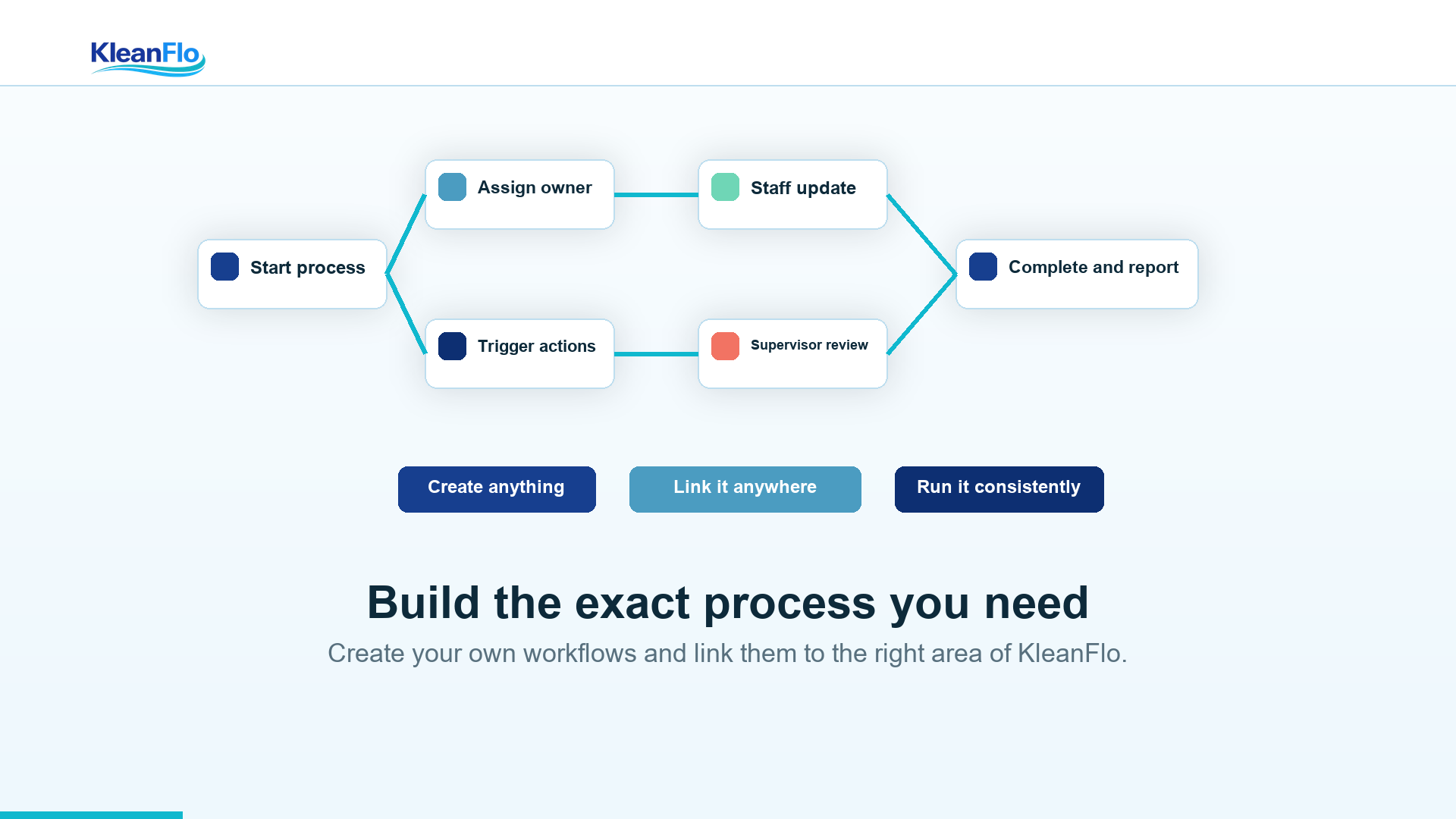
A cleaning company can run onboarding from a paper checklist, but the risk is that steps get missed, chased late or stored in separate places. A configurable process helps the business create the exact onboarding flow it needs, then repeat it consistently.
In KleanFlo, users can create their own process flows and link them to the employee area of the system. A business could create a new starter onboarding process that matches its own steps, such as manager approval, right-to-work confirmation, contract generation, document issue, mobile app setup, training acknowledgement, site allocation and first-week review.
Where the workflow requires it, the contract or documents can be generated and sent to the staff mobile app for the employee to review and sign. That keeps the onboarding action with the person who needs to complete it, rather than relying on loose emails or manual chasing.
For the product view of this, see how KleanFlo process automation can be used to build an onboarding workflow with documents, forms, mobile signature actions and supervisor approvals.
1Create your own onboarding flowBuild the action set around your real process rather than forcing every new starter through a fixed checklist.
2Trigger it at the right timeStart onboarding manually or use automation rules where the business wants the process to begin from a defined event.
3Send actions to staff mobileGive employees the right documents, acknowledgements or process actions from the app they already use for work.
4Keep a recordTrack what was issued, completed, signed, chased or reviewed, so the business has a clearer audit trail when questions arise.
Common onboarding mistakes in cleaning companies
- Starting staff before right-to-work, payroll and basic records are complete.
- Assuming an experienced cleaner does not need site-specific induction.
- Issuing documents without recording acknowledgement.
- Relying on WhatsApp messages for permanent site instructions.
- Forgetting to explain check-in, check-out, absence and incident reporting.
- Not checking whether the employee can log into the mobile app before the first shift.
- Giving keys, codes or access instructions without a clear return or offboarding process.
- Failing to schedule a first-week review to catch early problems.
Useful official references
The sources below are useful starting points when designing or reviewing a staff onboarding process. They should be checked alongside your own employment, payroll and health and safety advice.