Integration guide

Accounting, e-signature, calendar, email and storage

Cleaning software integrations for cleaning companies

KleanFlo is not designed to trap a cleaning company in another isolated system. It connects cleaning operations with the accounts, calendar, email, e-signature and file-storage tools already used by the business, so customer records, staff records, invoices, appointments and documents can move through a controlled workflow.

Xero QuickBooks FreeAgent DocuSign Signable Microsoft 365
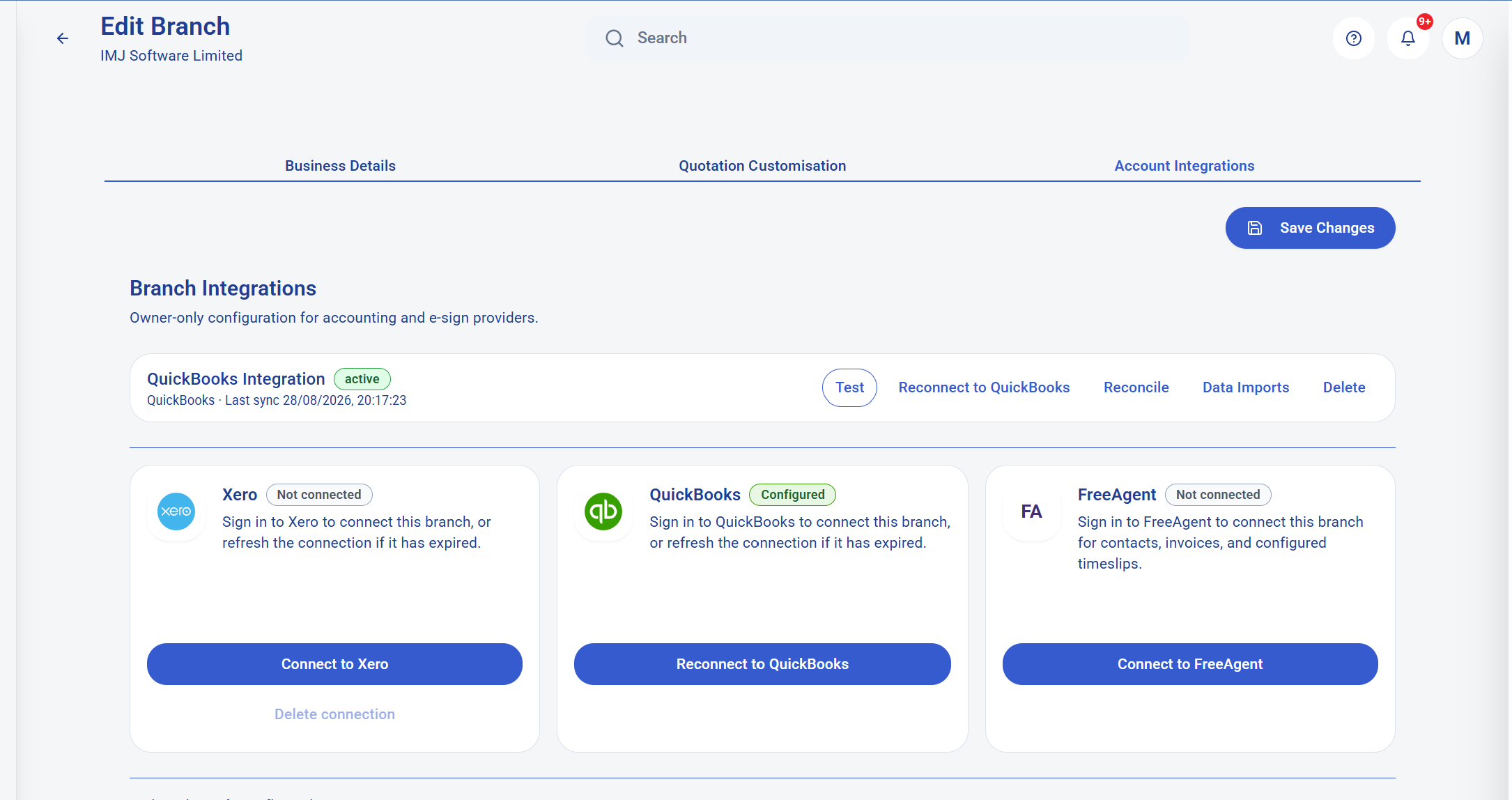
KleanFlo branch integrations screen showing Xero, QuickBooks and FreeAgent account integrations

Why integrations matter for cleaning companies

Cleaning businesses usually hold the same core people and company information in several places. A customer may exist in the accounts package, the cleaning rota, the quotation process, the customer portal and the invoice process. A staff member may exist in the cleaning schedule, mobile app, payroll records and accounting or payroll system. When those records are not connected, the office ends up retyping names, addresses, emails, payroll identities and invoice details.

KleanFlo's integration approach is built around the operational record. The cleaning system remains the place where contracts, sites, schedules, audits, attendance and mobile work are managed. The accounts package remains the finance system of record. Integrations reduce duplicate entry between them and help the business keep customer, staff, invoice and timesheet records aligned.

The practical goal is simple: link or import the people and organisations you already have, run the cleaning operation in KleanFlo, then pass finance-ready information back to the right connected system where supported.

What KleanFlo can connect

KleanFlo supports several integration types because cleaning companies do not all run the same back office. Some use Xero, some use QuickBooks, some use FreeAgent, some need DocuSign or Signable for contract documents, and many need calendar and email integrations for surveys, appointments, customer messages and internal workflows.

Integration areaSupported providers and purpose
AccountingXero, QuickBooks and FreeAgent for customer records, staff records, reconciliation, importing and finance workflow support.
E-signatureSignable and DocuSign for dispatching generated documents for signature from controlled branch-level workflows.
Calendar and emailGoogle Calendar and Gmail, Microsoft 365, Exchange Calendar, CalDAV Calendar and custom SMTP email for appointments, calendar writes and outgoing email workflows.
File storageOneDrive file storage for branch-level storage of selected customer, staff and operational uploads.
Data importCSV and provider-backed import workflows for customers, prospects, staff and related setup data.

Branch-level account integrations

Accounting and e-signature integrations are configured at branch level by authorised owner users. That matters for cleaning companies with more than one trading branch, franchise, region or legal setup. One branch may use Xero while another uses QuickBooks. One branch may want a different connected account or different document signing provider. KleanFlo keeps that configuration attached to the branch rather than treating every company as a single flat account.

The branch integrations screen shows connection state, provider name, last sync information and action buttons for testing, reconnecting, reconciling, importing data or deleting a connection. This gives owners an operational control panel instead of burying integrations inside a technical settings page.

KleanFlo branch account integrations with QuickBooks active and Xero and FreeAgent connection options Branch integrations give owners one place to connect, test, reconnect, reconcile and import accounting data.

Accounting systems

Connect Xero, QuickBooks or FreeAgent without rebuilding your cleaning database from scratch

If a cleaning company already has customers and staff in an accounts package, KleanFlo can help reuse that information. Connected accounting providers can be used to list external customers and employees, import selected records, link existing KleanFlo records to accounting records, and review unmatched records that still need action.

This is especially useful during onboarding. Instead of starting with a blank cleaning system, the business can bring across customer and staff data, then build cleaning-specific detail such as sites, contracts, schedules, access notes, mobile app setup, audits and attendance rules inside KleanFlo.

Customer linking and importing

Customer records are the bridge between the accounts package and the cleaning operation. In the accounts package, the customer is usually a contact or company used for billing. In KleanFlo, the customer also connects to sites, contracts, schedules, contacts, site assessments, documents, audits, customer portal visibility and operational history.

KleanFlo can list customers from Xero, QuickBooks or FreeAgent and compare them with existing local customer records. Suggested matches can use signals such as existing external IDs, customer name, primary contact email and postcode. This helps the office decide whether a provider record should be linked to an existing KleanFlo customer, imported as a new customer, synced from KleanFlo to the provider, or ignored where it is not relevant.

Customer scenarioHow KleanFlo helps
Customer already exists in KleanFlo and XeroLink the KleanFlo customer to the Xero contact so future finance actions know which external record to use.
Customer exists in QuickBooks but not KleanFloImport the customer into KleanFlo and continue setup with sites, contacts, schedules and cleaning contracts.
Customer exists in KleanFlo but not the accounts packageSync the local customer to the provider where supported, using customer and primary contact details.
Provider record is old or irrelevantIgnore it in the reconciliation workflow so the same record does not keep distracting the setup team.

Staff linking and importing

Staff records are just as important as customer records. Cleaning businesses need staff in KleanFlo for schedules, mobile app access, check-in and check-out, supervisor assignment, absences, cover shifts, timesheet review, documents and training or onboarding processes. The accounts or payroll environment may already hold employee records that should not be typed again.

KleanFlo can list employees or users from connected Xero, QuickBooks and FreeAgent accounts and compare them with local staff records. Suggested staff matches can use existing external IDs, email address, name and date of birth where available. Staff import can create active employed staff records with contact details and provider IDs attached, giving the office a faster path from accounts data to operational staff setup.

Staff data pointWhy it matters after import or linking
Name and emailSupports staff identity, app invitations, communication and reconciliation with accounting employee records.
Phone and mobileSupports supervisor contact, mobile workforce operations and absence or cover communication.
External employee IDPrevents the same worker being recreated repeatedly and gives payroll or timesheet posting a provider reference.
Employment statusHelps distinguish active employed cleaners from old or irrelevant records during setup and reconciliation.

Reconciliation keeps duplicated records under control

Importing everything blindly can create a mess. KleanFlo therefore treats reconciliation as a separate workflow. It can show provider records beside local records, suggest matches, mark confidence, and let the owner decide what to link, sync or ignore. That gives the business control over data quality instead of relying on a one-time import that may duplicate customers or employees.

For larger cleaning companies, this is one of the most important parts of the integration story. A customer may have changed name. A staff member may use a personal email in one system and a work email in another. A postcode may be missing. Reconciliation gives the office a review queue so the integration can be cleaned up deliberately.

Invoices, one-off jobs and accounting

KleanFlo's operational workflow can create invoice-ready records from cleaning work, especially for one-off jobs and completed work. Where Xero or QuickBooks is connected and configured, the invoice workflow can post selected invoice records into the accounting system rather than forcing the office to retype the invoice after the job is complete.

This is useful for commercial cleaning jobs where the operational team captures the customer, site, job detail, price, schedule and completion evidence in KleanFlo, but the finance team still needs the final invoice in the accounts package. The integration reduces duplicate work while keeping finance records inside the accounting system the business already trusts.

Payroll hours and timesheet posting

Cleaning payroll is difficult because the planned schedule and the actual attendance record are often different. Staff may start late, leave early, cover another cleaner's shift, complete a one-off job, or work across several customer sites. KleanFlo helps gather the operational evidence first: planned shift, check-in, check-out, actual duration, missing records, notes and review status.

When provider configuration supports it, KleanFlo can use connected accounting or payroll records to help post approved payroll-related hours or timesheet information. The important distinction is that KleanFlo is not just exporting a raw clock-in list. It is preparing reviewed operational hours from cleaning schedules and attendance evidence, then connecting those records to the appropriate provider identity where supported.

E-signature

Send customer and staff documents through Signable or DocuSign

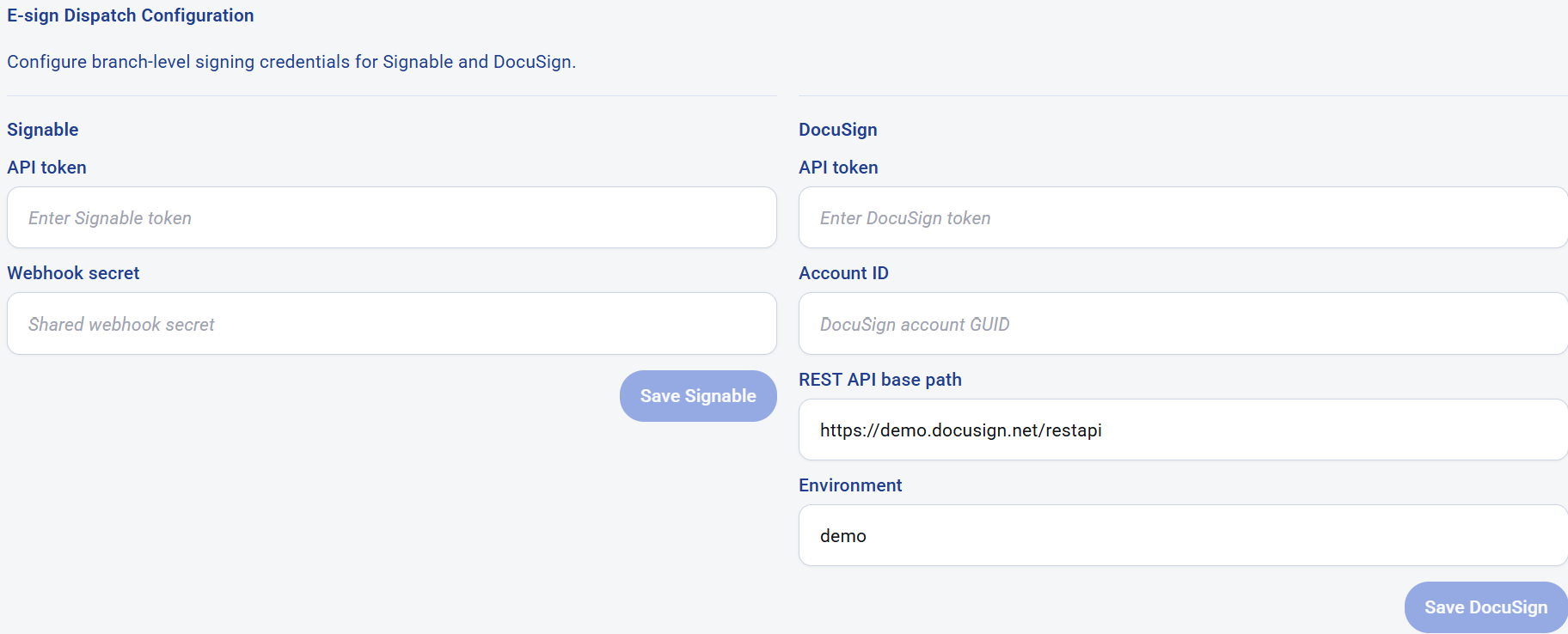
Cleaning companies often need signed documents: accepted quotations, contract documents, staff forms, policy acknowledgements, onboarding documents, customer declarations and other generated paperwork. KleanFlo supports branch-level e-signature dispatch configuration for Signable and DocuSign so documents can be sent from controlled workflows rather than downloaded, emailed manually and chased separately.

Branch-level configuration keeps signing credentials under owner control. Signable uses API token and webhook-secret configuration. DocuSign configuration can hold the API token, account ID, REST API base path and environment, allowing demo and live setups to be handled deliberately.

KleanFlo e-sign dispatch configuration for Signable and DocuSign credentials E-signature dispatch settings let branch owners configure Signable and DocuSign credentials.
Calendar and email integrations

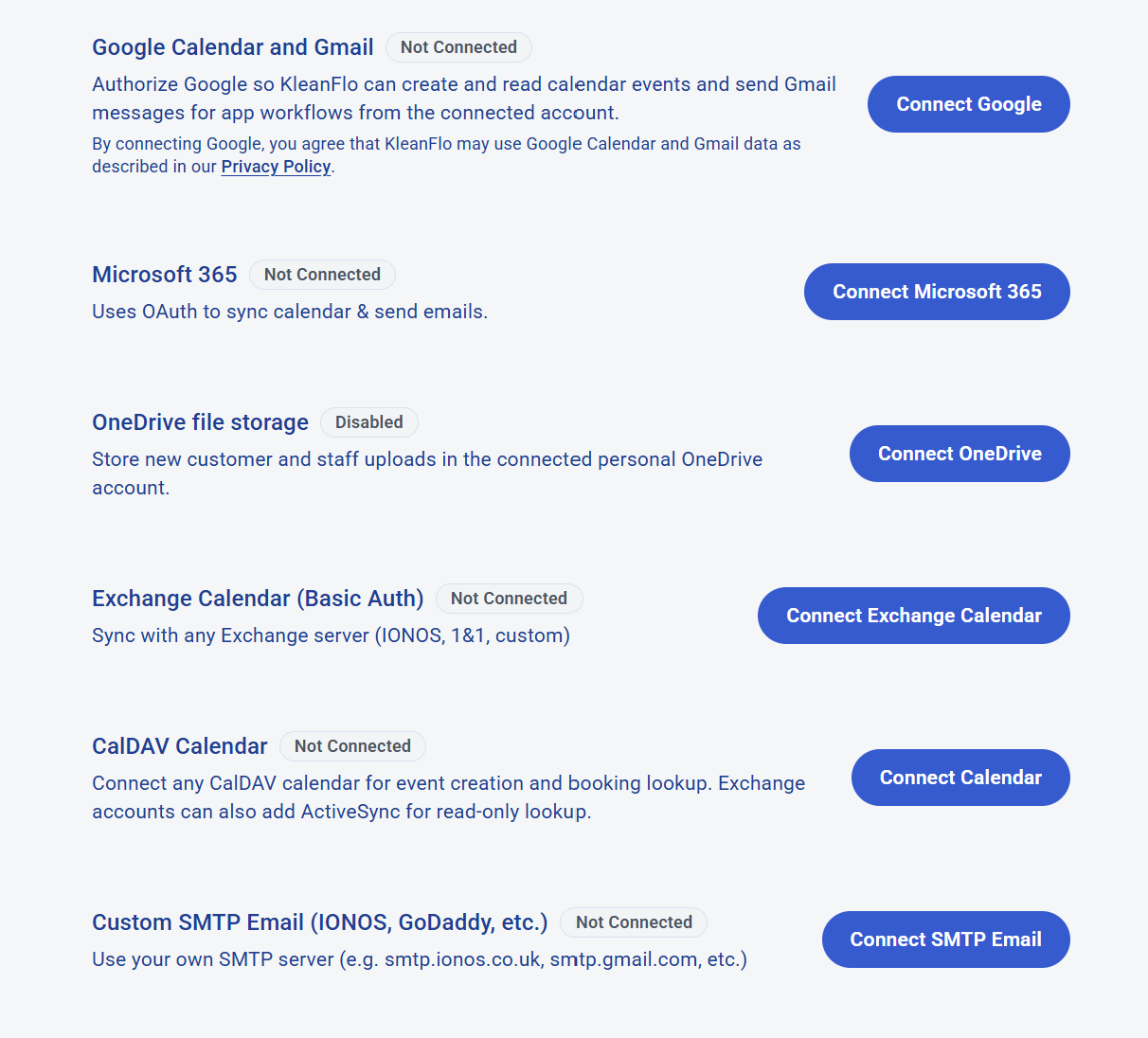
KleanFlo also supports user-level calendar and email integrations. These are used where app workflows need to create or read calendar events, send appointment messages, or send outgoing emails from an authorised account. This can support site surveys, quotation appointments, customer visits, internal calendar visibility and email workflows.

The supported options are deliberately broad. Google Calendar and Gmail can be connected together. Microsoft 365 can be connected through OAuth. Exchange Calendar can support Exchange server setups. CalDAV can be used for calendar event creation and booking lookup where a provider exposes CalDAV. Custom SMTP can be used where the business wants outgoing messages sent through its own SMTP server.

KleanFlo settings screen showing Google Calendar and Gmail, Microsoft 365, OneDrive, Exchange Calendar, CalDAV and SMTP connections User and branch integrations cover Google, Microsoft 365, OneDrive, Exchange, CalDAV and SMTP workflows.

Appointments and messages

Use connected calendars and mailboxes for real workflows

Calendar integration is not only about showing a diary. In KleanFlo, appointment workflows can use connected accounts to create events and send customer-facing messages from the right account where configured. For example, a site survey can be booked against the lead owner or allocated user so the calendar event and customer communication follow the person responsible for the visit.

Email integration also reduces manual chasing. Instead of copying appointment details into a separate email account, KleanFlo can support structured outbound messages from connected Google, Microsoft or SMTP-style accounts where the user's configuration allows it.

OneDrive file storage

Document storage matters because cleaning operations generate a lot of attachments: customer files, staff documents, equipment records, incident evidence, quotation attachments, generated documents and onboarding files. KleanFlo can support branch-level OneDrive storage for selected uploads, helping the business keep files in the connected Microsoft environment rather than scattering them through personal downloads and email attachments.

OneDrive storage is controlled at branch level. Owner users can enable it for a branch, and uploads can resolve the relevant branch before storing files. This matters for larger businesses because staff documents, customer documents and incident records need to remain under the correct business branch and access model.

Personal integrations vs branch integrations

KleanFlo separates personal user integrations from branch-level owner integrations because they solve different problems. Calendar and email accounts are often personal or role-based accounts used by individual users. Accounting, e-signature and file-storage connections are more often branch-wide business controls.

Configuration typeTypical use
Branch owner integrationsXero, QuickBooks, FreeAgent, Signable, DocuSign and OneDrive storage where the branch needs a controlled business connection.
User integrationsGoogle, Microsoft 365, Exchange, CalDAV and SMTP connections where calendar and email workflows should use an authorised user account.
Testing and reconnectingConnection checks, reconnect actions and status indicators help the owner or user see whether the integration is currently usable.

How this helps during onboarding

For a cleaning company moving from spreadsheets, integrations can shorten the route to a live system. The setup team can import or link existing customers and staff, then add the cleaning-specific records that accounts packages do not usually hold: sites, rooms, zones, designations, tasks, schedules, mobile app access, access notes, audit templates, documents and customer portal settings.

This is the point that matters commercially. Xero, QuickBooks and FreeAgent may know who the customer is, but they do not know how a school, office, surgery, gym or managed apartment block should be cleaned. KleanFlo uses integration data as the starting point, then builds the operational layer needed to deliver the service.

Security, access and practical control

Integration data can contain personal, commercial and financial information. KleanFlo therefore keeps sensitive integration actions behind authenticated access and uses owner-level controls for branch accounting and e-signature configuration. Users can manage their own personal calendar and email integrations where permitted, while branch-level storage and accounts connections remain under stronger owner control.

For customers, the practical benefit is confidence: integrations are there to reduce duplicate work and keep operational records aligned, not to expose every connected system to every user. The connected provider, branch, user role and workflow determine what is available.

What to check before connecting an accounts package

  • Which branch should own the integration?
  • Which provider will be used: Xero, QuickBooks or FreeAgent?
  • Do you want to import customers, staff or both?
  • Which existing records should be linked rather than duplicated?
  • Which customers are active cleaning customers and which are old finance records?
  • Which staff are active employed cleaners and which are historic or non-operational records?
  • Should invoice or timesheet posting be enabled for the provider and tier?
  • Who in the business is allowed to test, reconnect, reconcile or delete the integration?

Where integrations sit in the wider KleanFlo workflow

Integrations are most valuable when they support the rest of the cleaning workflow. A linked customer can feed quotation and contract setup. Imported staff can be assigned to schedules and mobile app workflows. Connected calendar accounts can support site survey appointments. E-signature providers can send generated customer or staff documents. OneDrive can store operational files. Accounting connections can reduce retyping when invoices or payroll-related records need to move into the finance process.

That is why this page is not just a list of logos. The integration layer exists to join the cleaning business process together: customer setup, staff setup, quotes, schedules, attendance, audits, documents, customer communication, invoices and payroll preparation.

Integration summary

What KleanFlo integrations are designed to reduce

The strongest integration outcome is less duplicate admin and cleaner operational handover between systems.

1

Duplicate customer entry

Import or link provider customer records so customer setup starts from existing account data.

2

Duplicate staff entry

Import or reconcile staff from supported providers so cleaner records are easier to prepare for scheduling and mobile use.

3

Manual invoice retyping

Use connected accounting workflows where configured so completed invoice records can move into the finance system.

4

Uncontrolled document signing

Send generated documents through configured Signable or DocuSign dispatch workflows.

5

Separate appointment admin

Use connected calendars and email accounts for surveys, visits and customer communication workflows.

6

Scattered file storage

Use branch-level OneDrive storage where configured for selected customer, staff and operational uploads.

Frequently asked questions

Does KleanFlo connect to Xero?

Yes. KleanFlo supports Xero as a branch-level accounting integration. Xero workflows can support connected customer records, staff records, reconciliation, importing, invoices and payroll-related timesheet workflows depending on configuration and tier.

Does KleanFlo connect to QuickBooks?

Yes. KleanFlo supports QuickBooks as a branch-level accounting integration. QuickBooks workflows can support customer and employee listing, linking, importing, reconciliation and selected invoice or payroll-hour posting workflows depending on configuration.

Does KleanFlo connect to FreeAgent?

Yes. KleanFlo supports FreeAgent as a branch-level accounting integration. FreeAgent can be used for customer and staff import or reconciliation workflows where the connected account and configuration support it.

Can staff and customers be linked to accounts package records?

Yes. KleanFlo can store external provider IDs against customer and staff records, allowing a KleanFlo customer or staff member to be linked to the matching Xero, QuickBooks or FreeAgent record.

Can we import existing data from accounts software?

Yes. KleanFlo can import customers and staff from connected accounting providers, helping the onboarding process start from existing records instead of forcing the business to recreate every record manually.

Does KleanFlo replace the accounts package?

No. KleanFlo manages the cleaning operation: customers, sites, contracts, schedules, staff mobile work, audits, attendance and documents. The accounts package remains the finance system. Integrations help the two systems work together.

Can KleanFlo send documents for signature?

Yes. KleanFlo supports e-signature dispatch configuration for Signable and DocuSign so generated documents can be sent for signature from controlled workflows.

Can KleanFlo use our business email or calendar?

KleanFlo supports Google Calendar and Gmail, Microsoft 365, Exchange Calendar, CalDAV Calendar and custom SMTP email integrations. These can support appointment, calendar and outbound email workflows from connected accounts.

Want KleanFlo connected to the systems you already use?

Talk to us about Xero, QuickBooks, FreeAgent, e-signature, calendar, email, OneDrive, data import and reconciliation workflows for your cleaning business.

Book a Demo