School cleaning KPIs every contractor should track
Published: 16 July 2026Last updated: 16 July 2026Reading time: 15 minutes
School cleaning KPIs should show whether the contract is clean, covered, compliant,
profitable and under control. The best KPIs help contractors act before standards slip,
customers complain, payroll hours drift or a contract becomes harder to retain.
QualityAttendanceComplianceProfitability
In this guide
What makes a good school cleaning KPI
Quality and audit KPIs
Attendance and cover KPIs
Compliance and safety KPIs
Customer experience KPIs
Commercial and margin KPIs
KPIs need evidence
A KPI is only useful if the underlying data is trusted. That means schedules,
attendance, audits, incidents and customer communication need to be recorded
consistently.
School cleaning contracts can look stable from the outside while problems build
underneath. A cleaner arrives late every week. Washroom complaints are increasing.
Holiday deep-clean tasks are behind plan. Labour hours are creeping above budget.
Audit failures are being recorded but not closed.
KPIs give contractors a way to see those patterns early. They are not just numbers for
a management report. Used properly, they help supervisors focus, account managers
prepare for customer reviews, and business owners understand whether a contract is
healthy.
A good KPI should trigger a decision. If nobody changes behaviour when the number
moves, it is probably a vanity metric rather than a useful operational measure.
What makes a useful school cleaning KPI?
The most useful KPIs are specific, measurable and connected to action. A vague target
such as "keep the school clean" is not enough. Contractors need measures that show
whether cleaning standards, staffing, service issues and contract costs are moving in
the right direction.
It can be measured from reliable operational data.
It is reviewed at the right frequency.
It has an owner who can act on it.
It connects to customer confidence, contract performance or profitability.
It is clear enough to explain to supervisors and managers.
The school cleaning KPI framework
A balanced school cleaning KPI set should cover six areas: quality, attendance,
responsiveness, compliance, customer experience and commercial control. If the KPI set
only measures one area, such as audit scores, the contractor may miss problems in
labour cost, staff reliability or customer communication.
KPI areaWhat it tells you
QualityWhether classrooms, washrooms, circulation areas and shared spaces are meeting the agreed standard.
Attendance and coverWhether planned cleaning hours are actually being delivered and whether absence is disrupting the service.
ResponsivenessHow quickly issues, complaints, incidents and failed audit items are acknowledged and resolved.
Compliance and safetyWhether documents, training, COSHH, site rules, incidents and safeguarding processes are being managed.
Customer experienceWhether the school feels informed, confident and listened to.
Commercial controlWhether labour, materials, rework and management time are still aligned with the priced contract.
1. Cleaning audit score
The audit score is usually the most visible quality KPI. It should show whether the
school is being cleaned to the agreed standard across key areas such as classrooms,
washrooms, corridors, halls, offices and high-touch points.
Measure: average audit score by site, zone, area or month.
Why it matters: it gives a structured view of cleaning quality rather than relying on complaints.
Review frequency: weekly for supervisors, monthly for contract reviews.
Watch for: high average scores hiding repeated failures in one high-risk area.
2. Audit completion rate
A strong audit plan is only useful if audits are actually completed. If planned audits
are repeatedly missed, the contractor loses visibility and the school may question how
standards are being monitored.
Measure: completed audits divided by scheduled audits.
Why it matters: it shows whether the quality programme is being followed.
Review frequency: weekly or monthly.
Watch for: audits completed late, rushed, or only after complaints.
3. Corrective action closure rate
Failed audits are not the real problem. The real problem is a failed audit that never
leads to action. Corrective action closure shows whether issues are being followed
through.
Measure: actions closed on time divided by actions raised.
Why it matters: it proves the contractor is not just recording issues but resolving them.
Review frequency: weekly for open items, monthly for trend reporting.
Watch for: repeated extensions, unclear ownership or actions closed without evidence.
4. Repeat failure rate
Repeat failures show where a contract needs deeper attention. If the same washroom,
classroom block or corridor keeps failing, the cause may be training, time allocation,
access, equipment, poor specification detail or unrealistic frequency.
Measure: number of repeated failed checks for the same area, task or issue.
Why it matters: it helps supervisors find root causes rather than treating every issue as isolated.
Review frequency: monthly.
Watch for: recurring problems being hidden in free-text notes.
5. Attendance completion rate
School cleaning relies on short windows of time. If cleaners do not attend, arrive
late or leave early, there may be no easy way to recover the missed work before the
school day starts.
Measure: completed shifts divided by planned shifts.
Why it matters: attendance is the foundation of service delivery.
Review frequency: daily or weekly.
Watch for: sites that appear covered but rely on regular supervisor rescue.
6. Missed shift and late-start count
A high attendance percentage can still hide repeated late starts. Schools are sensitive
to morning standards, so contractors should track missed shifts and late starts
separately.
Measure: missed shifts, late starts and early finishes by site or staff member.
Why it matters: it highlights reliability risk before it becomes a customer complaint.
Review frequency: daily for exceptions, weekly for trends.
Watch for: patterns around specific days, buildings or team members.
7. Absence cover response time
Staff absence is inevitable. The KPI is not whether absence happens; it is how quickly
the contractor identifies the gap and puts suitable cover in place.
Measure: time from absence notification to cover confirmed.
Why it matters: fast cover protects standards and reduces school disruption.
Review frequency: weekly or monthly.
Watch for: cover being arranged informally without schedule or payroll records being updated.
8. Complaint rate
Complaint volume is a useful KPI, but it should be interpreted carefully. A school that
raises issues early may be helping the contractor improve. A school that says nothing
for months and then escalates may be less visible but more risky.
Measure: complaints per month, per site, per area or per 100 cleaning shifts.
Why it matters: it shows where customer confidence may be weakening.
Review frequency: weekly for open complaints, monthly for trend reporting.
Watch for: repeated low-level complaints that are not treated as a trend.
9. Complaint resolution time
Schools do not expect perfection, but they do expect concerns to be acknowledged and
resolved properly. Resolution time helps contractors measure how well issues move from
report to action.
Measure: average time from complaint raised to action completed.
Why it matters: it protects trust and shows operational responsiveness.
Review frequency: weekly for open items, monthly for contract reviews.
Watch for: complaints marked closed without customer confirmation where that is required.
10. Periodic work completion
School contracts often include holiday deep cleans, floor work, carpet cleaning,
high-level dusting, washroom deep cleans or classroom resets. These tasks need their
own KPI because they do not always appear in the daily rota.
Measure: completed periodic tasks divided by planned periodic tasks.
Why it matters: it shows whether the annual specification is being delivered, not just daily cleaning.
Review frequency: after each holiday period and monthly for planned work.
Watch for: tasks missed because of school access, building works or unclear ownership.
11. Incident reporting rate
Incidents can include spillages, access problems, damage, equipment faults, safety
concerns, site hazards or issues that affect cleaning delivery. A very low incident
count is not always good if staff are simply not reporting problems.
Measure: incidents reported by site, type, severity and month.
Why it matters: it helps managers spot safety and operational risks.
Review frequency: weekly for serious issues, monthly for trends.
Watch for: staff using informal messages instead of the agreed reporting process.
12. Compliance document completion
School cleaning contractors often need to evidence documents such as risk assessments,
method statements, COSHH information, training records, site inductions and safeguarding
confirmations. Missing documents can create risk during audits, reviews or incidents.
Measure: completed documents or records divided by required documents or records.
Why it matters: it keeps contract assurance and internal governance under control.
Review frequency: monthly, and before contract reviews or new-term starts.
Watch for: documents uploaded once and never reviewed when site conditions change.
13. Training and induction completion
New starters, cover cleaners and transferred staff need to understand the site, the
specification, safeguarding expectations, mobile app, incident reporting and safe
working methods. Training completion should be tracked, not assumed.
Measure: staff with completed induction/training divided by staff requiring it.
Why it matters: training gaps often become quality, safety or customer issues.
Review frequency: weekly during mobilisation, monthly once stable.
Watch for: cover staff working on site without the same briefing as regular staff.
14. Labour hours against budget
School cleaning margins can be damaged quietly when actual hours exceed planned hours.
A few extra minutes per shift, repeated supervisor rescue, unpaid rework or unmanaged
cover can change the profitability of a contract.
Measure: actual paid hours compared with budgeted or contracted hours.
Why it matters: labour is usually the largest contract cost.
Review frequency: weekly for exceptions, monthly for margin review.
Watch for: extra hours caused by complaints, poor scheduling, absence or unrealistic task times.
15. Reclean and rework hours
Rework is one of the clearest signs that standards or process are not stable. It can
protect the customer relationship in the short term, but repeated rework damages margin
and supervisor capacity.
Measure: time spent correcting missed or failed work.
Why it matters: it shows the hidden cost of poor quality.
Review frequency: monthly.
Watch for: rework hidden inside normal supervisor visits.
16. Customer review health
Not every important signal is numeric. Customer review health can capture whether the
school is satisfied, whether issues are reducing, whether communication is working and
whether renewal risk is increasing.
Measure: review outcome, customer sentiment, open concerns and renewal risk rating.
Why it matters: it connects operational KPIs to contract retention.
Review frequency: monthly or termly depending on contract size.
Watch for: good audit scores but poor customer confidence because communication is weak.
Suggested KPI dashboard for school cleaning contracts
Contractors do not need hundreds of metrics. A strong dashboard should show enough
information to run the contract, prepare for reviews and spot risk early.
Complaints and response timeWeekly for open issues, monthly for trends.
Periodic work completionMonthly and after each school holiday period.
Actual hours vs budgetWeekly for exceptions, monthly for margin review.
Training and compliance recordsMonthly and before major reviews or new-term starts.
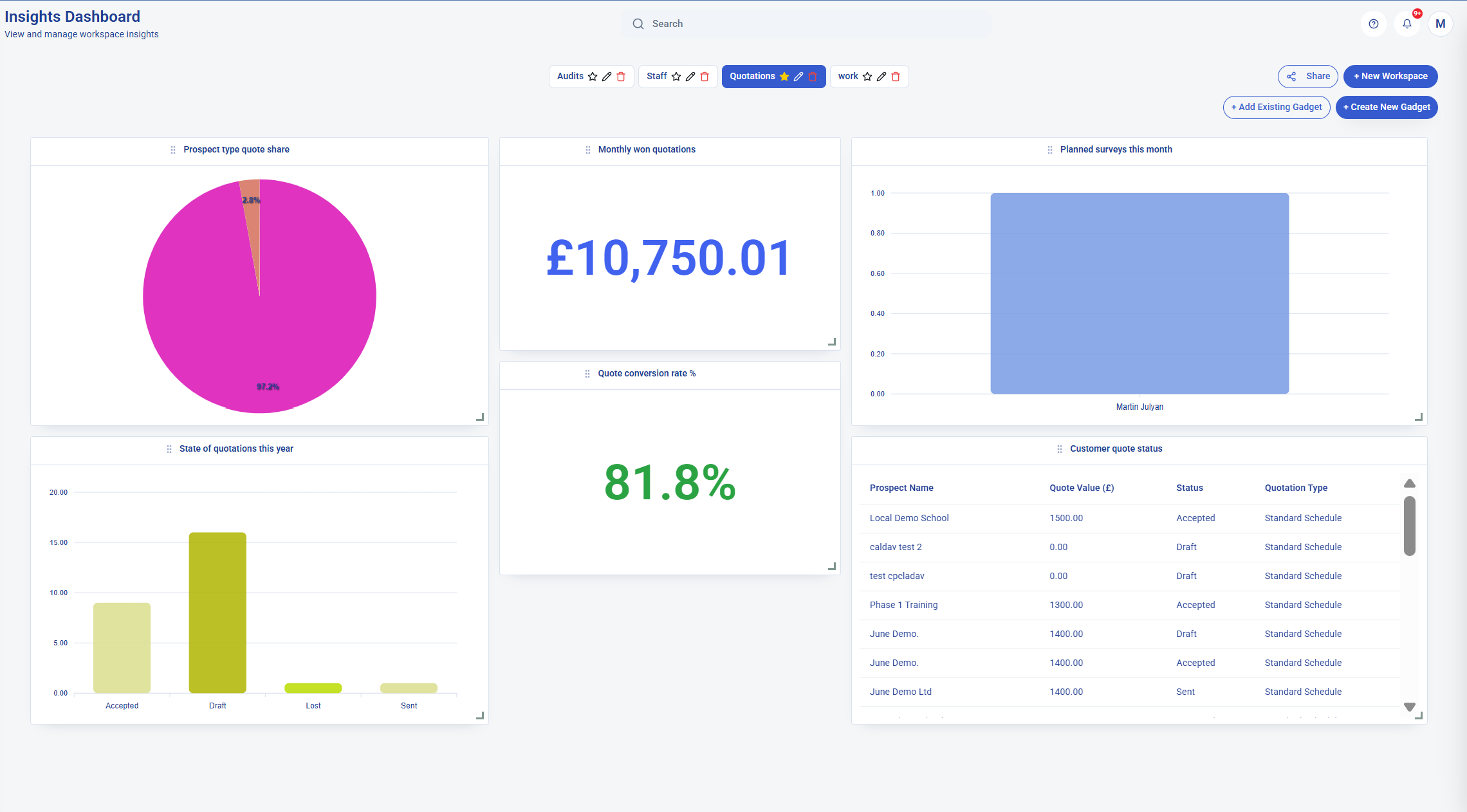
KPIs are most useful when managers can see quality, staffing, attendance and commercial signals together.
How KleanFlo helps track school cleaning KPIs
KleanFlo helps cleaning companies connect the data that normally sits in separate
places: schedules, staff mobile activity, audits, incidents, conversations, customer
records, timesheets and reporting. That makes KPI tracking more practical because the
evidence comes from day-to-day operations.
Schedules show planned shifts, sites and work patterns.
Staff mobile check-in and check-out support attendance and time records.
Audits provide quality scores, photos, notes and follow-up items.
Incidents and conversations keep service issues visible.
Timesheet review helps compare actual hours against planned hours.
Customer portal and reporting support review conversations with schools.
Official guidance and useful context
KPI targets should be aligned with the contract, school policies and any agreed service
level requirements. Contractors should also consider relevant UK guidance where KPIs
involve safety, safeguarding, infection control or employment processes.
How many KPIs should a school cleaning contractor track?
Track enough KPIs to manage the contract without overwhelming supervisors. Around
eight to twelve well-chosen KPIs is usually more useful than a long report nobody
reviews properly.
Should audit score be the main school cleaning KPI?
Audit score is important, but it should not stand alone. Attendance, complaints,
corrective actions, periodic work and labour hours often reveal problems that audit
scores miss.
Are KPIs useful for small school cleaning contracts?
Yes. Smaller contracts may need fewer KPIs, but attendance, quality, complaints and
labour hours still matter. Simple tracking can stop small issues becoming renewal
risks.
Who should review school cleaning KPIs?
Supervisors should review operational KPIs, account managers should review customer
and contract KPIs, and business owners or senior managers should review margin,
retention and recurring risk.
Related resources
Improve school cleaning performance
Use these guides to connect KPIs with audits, mobilisation, attendance and customer confidence.